

- Cart 0
- English
How does normal rabbit serum build a background barrier in immunoassays?
April 30, 2026
Clicks:72


In immunoassays such as immunohistochemistry (IHC) and enzyme-linked immunosorbent assay (ELISA), non-specific background staining is a common challenge for researchers. When antibodies cross-react with non-target components in samples or non-specific binding occurs in the detection system, false-positive signals mask the true antigen-antibody reaction. Normal Rabbit Serum, a classic biological blocking agent, forms a critical background barrier in immunoassays through its unique protein composition and immunoglobulin properties, effectively reducing false-positive rates and improving assay specificity and signal-to-noise ratio.
Why is serum blocking more effective than BSA in reducing background?
1. Blocking non-specific protein binding sites:
Tissue samples or solid-phase carriers (e.g., nitrocellulose membranes, ELISA plates) expose highly charged collagen, connective tissue components, or hydrophobic regions that readily adsorb subsequently added antibodies via electrostatic or hydrophobic interactions. Various serum proteins in rabbit serum (albumin, globulins, etc.) pre-occupy these "sticky" sites, forming a protein monolayer that prevents non-specific antibody binding.
2. Fc receptor blocking:
This is the unique advantage of serum blocking. Tissue cells (especially immune cells, epithelial cells) express Fc receptors (FcR) that bind the constant region (Fc segment) of antibodies independently of antigen specificity, a major cause of background staining. Rabbit serum contains rabbit immunoglobulins that pre-occupy Fc receptors in tissues, blocking non-specific binding of subsequent primary or secondary antibodies. As a single protein, BSA cannot block Fc receptors.
3. Homologous antibody pre-binding:
Endogenous antibodies in rabbit serum pre-occupy tissue antigenic sites that cross-react with rabbit antibodies, preventing background signals from subsequent rabbit primary or anti-rabbit secondary antibodies binding to these sites.
How does the Fc receptor blocking mechanism of rabbit serum work?
Fc receptor distribution:
Fc receptors are expressed on macrophages, monocytes, neutrophils, B cells, NK cells, and certain epithelial and tumor cells. When rabbit primary antibodies or goat anti-rabbit IgG secondary antibodies are used, their Fc segments may bind tissue Fc receptors independently of antigen recognition.
Blocking strategy:
Normal rabbit serum contains endogenous rabbit immunoglobulins (primarily IgG) that bind and saturate tissue Fc receptors. Since blocking serum IgG matches the species of detection antibodies (primary/secondary), it competes for the same Fc receptor sites, preventing non-specific binding of detection antibodies.
Selection principle:
Blocking serum must match the secondary antibody species. For example: primary antibody = rabbit anti-IL-2, secondary antibody = goat anti-rabbit IgG → use normal goat serum; primary antibody = goat anti-IL-2, secondary antibody = rabbit anti-goat IgG → use normal rabbit serum.
Which experimental scenarios best demonstrate its technical advantages?
Immunohistochemistry (IHC) Blocking
In IHC, rabbit serum is used in the following steps:
Tissue section blocking: After dewaxing and antigen retrieval, paraffin sections are incubated with 5-10% normal rabbit serum (diluted 1:10-1:20 in PBS) for 5-10 min at room temperature (or 10-30 min at 37°C). Remove excess serum without washing and add primary antibody directly.
Cell smear blocking: Fixed/permeabilized cell slides are covered with 5-10% rabbit serum (PBS-diluted) and incubated 10-20 min at room temperature. Proceed directly to primary antibody incubation without washing.
Dual staining blocking: Rabbit serum effectively reduces cross-reactivity between two antibody systems in IHC dual-color assays, improving staining specificity.
Enzyme-Linked Immunosorbent Assay (ELISA)
Usage of rabbit serum as blocking solution in ELISA:
Working concentration: Typically diluted 1:100 in PBS (0.01 mol/L, pH 7.4).
Incubation time: 1 hour at 37°C or overnight at 4°C.
Mechanism: Blocks unoccupied antigen-binding sites on ELISA plates to prevent non-specific antibody adsorption, and blocks potential Fc receptor sites (e.g., in cell lysate antigens).
Immunofluorescence (IF) Assay
Serum blocking is equally critical in immunofluorescence:
Reducing non-specific fluorescence: Serum blocking significantly lowers background fluorescence and improves signal-to-noise ratio.
Preventing antibody aggregation: Serum proteins stabilize antibody solutions, preventing aggregation or non-specific adsorption during dilution.
Western Blot (WB) Assay
While BSA is standard for WB, rabbit serum is effective in specialized cases:
Phosphoprotein detection: Some BSA batches contain phosphorylated protein contaminants; rabbit serum delivers cleaner backgrounds for phospho-specific antibody assays.
Low-abundance protein detection: Comprehensive site blocking by serum enhances detection sensitivity for low-expression target proteins.
How to optimize rabbit serum usage conditions?
Dilution Ratio and Buffer Selection
Recommended dilution: 5-10% (1:10 to 1:20). Increase to 10-20% for high-background tissues (connective tissue-rich samples); dilute to 1-5% for low-background samples.
Dilution buffer: 0.01 mol/L PBS (pH 7.2-7.4) or PBST (PBS + 0.1-0.3% Triton X-100) for permeabilized cell staining.
Incubation Condition Optimization
Temperature: Room temperature (20-25°C) or 37°C. 37°C shortens incubation (10-15 min); room temperature requires 15-30 min.
Time: 5-30 min, adjusted by tissue type and background. Tissue sections: 10-20 min; cell smears: 5-10 min.
Critical step: After blocking, remove excess serum WITHOUT WASHING (aspirate residual serum; do not rinse with buffer) before adding primary antibody. Washing removes weakly bound blocking proteins and reduces efficacy.
Serum Selection Strategy
Match secondary antibody species: Blocking serum must match the secondary antibody host. Examples:
- Primary: rabbit anti-IL-2, Secondary: goat anti-rabbit IgG → Block: normal goat serum
- Primary: goat anti-IL-2, Secondary: rabbit anti-goat IgG → Block: normal rabbit serum
Avoid matching primary antibody species: Blocking serum from the same species as the primary antibody may cause endogenous antibody-secondary antibody cross-reactivity, increasing background or reducing sensitivity.
Avoid human serum: Do not use human serum for human tissue assays to prevent human protein interference.
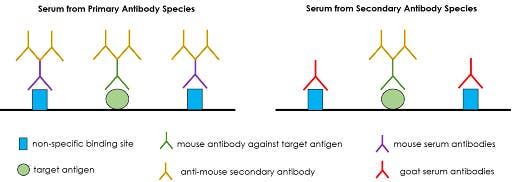
Left: Background caused by non-specific primary antibody binding (e.g., Fc receptors) without blocking. Right: Normal serum (matched to secondary antibody) pre-occupies Fc receptors and non-specific sites, preventing non-specific antibody binding and preserving only specific antigen-antibody reactions
Usage Notes and Storage Conditions
- Uninactivated & non-sterile: Rabbit serum is not heat-inactivated or sterile. For cell culture, inactivate at 56°C for 30 min (deplete complement) and filter-sterilize (0.22μm).
- Preservative-free: No preservatives added. Aliquot into small volumes (e.g., 1mL/tube) after reconstitution, store at -20°C, avoid freeze-thaw cycles. Short-term 4°C storage allowed but use promptly.
- Avoid hemolysis: Hemolyzed serum is unsuitable for blocking, as hemoglobin released from ruptured red blood cells increases background staining.
- Safety precautions: Wear lab coats and disposable gloves during handling to avoid skin/mucous membrane contact.
Technical Selection Considerations
- Background level: Serum blocking outperforms BSA for high-background tissues (skin, connective tissue-rich organs); BSA is more economical for low-background samples.
- Fc receptor expression: Mandatory serum blocking for immune cell/epithelial samples (high FcR); BSA sufficient for low FcR samples.
- Antibody species matching: Serum-blocking success depends on perfect species matching with secondary antibodies.
- Cost-benefit: Rabbit serum costs more than BSA but delivers superior results for high-value assays or intractable background issues.
Conclusion
As a classic blocking agent in immunoassays, normal rabbit serum provides dual functions—non-specific site blocking and Fc receptor blocking—via its rich protein components and endogenous immunoglobulins. In IHC, ELISA, IF, and other assays, selecting secondary antibody-matched rabbit serum and optimizing dilution/incubation conditions drastically reduce background staining and improve specificity/reliability. Mastering serum blocking principles and protocols is essential for high-quality immunoassay results.
Absin Rabbit Serum Recommendation:
| Cat. No. | Product Name | Size |
|---|---|---|
| abs946 | Rabbit Serum | 200mL |
Contact Absin
Absin provides antibodies, proteins, ELISA kits, cell culture, detection kits, and other research reagents. If you have any product needs, please contact us.
| Absin Bioscience Inc. worldwide@absin.cn |
 Follow us on Facebook: Absin Bio Follow us on Facebook: Absin Bio |