

- Cart 0
- English
Technical Characteristics and Cell Culture Strategies of High‑Glucose DMEM Medium
May 11, 2026
Clicks:72


As one of the most fundamental and widely used culture media in cell culture laboratories, Dulbecco's Modified Eagle Medium (DMEM) has become a standard tool for modern cell biology research since its development. In particular, the high‑glucose formulation (4500 mg/L glucose) supports numerous key experiments ranging from basic research to biopharmaceutical production by virtue of its optimized nutritional supply capacity.
What is High‑Glucose DMEM?
DMEM is a systematically modified medium derived from traditional Minimum Essential Medium (MEM). Its development logic stems from an in‑depth understanding of cellular nutritional requirements: compared with MEM, DMEM contains twice the concentration of amino acids and four‑fold higher levels of vitamins, supplemented with non‑essential amino acids, trace iron ions, pyruvate and other key metabolic substrates.
Originally designed with a glucose concentration of 1000 mg/L (low‑glucose type), DMEM was later developed into a high‑glucose formulation containing 4500 mg/L glucose to meet the demand for high‑density culture and fast‑proliferating cell lines. By providing abundant carbon sources and energy supply, the high‑glucose variant effectively supports metabolically active cell populations and has become the mainstream choice for adherent cell culture and hybridoma production.
Essential Differences Between High‑Glucose and Low‑Glucose DMEM
Glucose concentration is the core index distinguishing the two DMEM types. The difference between 4500 mg/L and 1000 mg/L is not merely numerical but represents distinct culture strategies:
High‑glucose DMEM is suitable for cell populations with rapid metabolism and proliferation. It maintains stable energy supply at high cell densities and reduces cell‑cycle disruption caused by frequent medium changes. For rapidly dividing systems such as transfected transformed cells and myeloma cells used in DNA transfection, a high‑glucose environment helps preserve post‑transfection cell viability.
Low‑glucose DMEM is more appropriate for cell types with slow metabolism or sensitivity to glycolysis‑related stress. It reduces lactic acid‑induced cytotoxicity in certain differentiation experiments or hypoxic conditions. Selection should be based on the metabolic characteristics of cell types and experimental purposes, rather than simply assuming "higher concentration is always better".
Key Functional Components in the Formulation
Taking standard high‑glucose DMEM as an example, its chemical composition precisely supports in‑vitro cell survival:
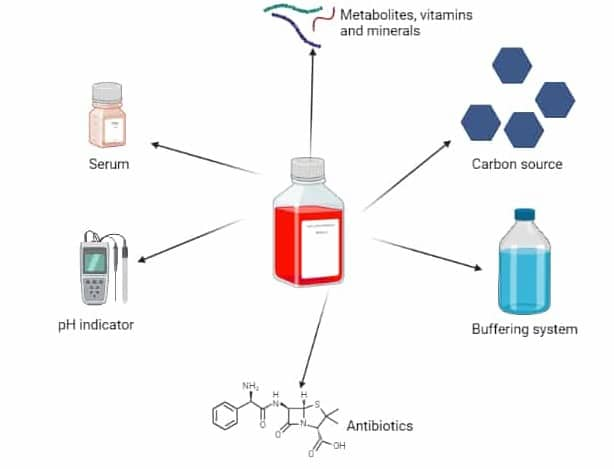
Energy and Carbon Source System: 4500 mg/L D‑glucose serves as the primary energy substrate, forming a dual‑carbon‑source system with 1 mM sodium pyruvate (included in some formulations). As an intermediate metabolite of the tricarboxylic acid (TCA) cycle, pyruvate provides an alternative energy pathway when glycolysis is restricted.
Nitrogen Source and Peptide Synthesis Precursors: 4 mM L‑glutamine is a critical precursor for cellular synthesis of purines, pyrimidines and amino acids, and also one of the most unstable components in medium. Supplemented trace iron ions support hemoglobin synthesis and activities of various iron‑dependent enzymes.
pH Buffering and Indicator System: 3700 mg/L sodium bicarbonate forms a CO₂‑dependent physiological buffer system that stabilizes pH in a 5% CO₂ incubator. 15 mg/L phenol red (optional) acts as a pH indicator, appearing red at pH 7.2–7.4, turning yellow upon medium acidification (lactic acid accumulation) and purple upon alkalization, offering direct visual monitoring of cellular metabolic status.
Why Is Additional Serum Required?
This is critical to understanding the design logic of basal culture media. Standard DMEM contains no proteins, lipids or growth factors, meaning it only provides essential inorganic salts, amino acids, vitamins and carbon sources for cell survival.
Key signaling molecules required for in‑vitro cell proliferation, including hormones, attachment factors, growth factors and lipids, must be supplied by adding serum (e.g., Fetal Bovine Serum, FBS) or serum‑free supplements (e.g., ITS supplements, customized growth‑factor cocktails). This modular design enables researchers to flexibly customize complete medium according to cell types and experimental needs, and facilitates serum‑free culture or specific factor deprivation assays.
Ideal Experimental Applications
High‑glucose DMEM is applied across nearly all fields of modern cell biology:
In tumor and translational research, it is the standard medium for culturing hybridoma myeloma cells and screening/amplifying cells after DNA transfection. Its high nutritional density supports high‑density culture and continuous passaging of transformed cells.
In biopharmaceutical and vaccine manufacturing, high‑glucose DMEM is commonly used as basal medium for industrial production processes such as recombinant erythropoietin (EPO) expression and hepatitis B vaccine production in Chinese Hamster Ovary (CHO) cells, combined with fed‑batch or perfusion culture strategies for efficient protein expression.
For viral infection and amplification assays, primary viral host cells such as Vero and HEK293 cell lines rely on the stable microenvironment provided by this medium to support viral replication and titer elevation.
Furthermore, high‑glucose DMEM plays an essential role in single‑cell clone screening, short‑term primary cell maintenance and construction of the basal layer for organoid culture.
Phenol Red‑Containing or Phenol Red‑Free: How to Choose?
The presence or absence of phenol red is an often‑overlooked yet critical technical detail in medium selection.
Standard phenol‑red‑containing medium allows routine visual monitoring, enabling rapid judgment of medium replacement needs or contamination via color changes. However, studies indicate that phenol red mimics steroid hormones (especially estrogen). Therefore, phenol‑red‑free medium is recommended for culturing breast tissue, endometrial cells and other estrogen‑sensitive cell lines to avoid signaling interference.
In addition, phenol red interferes with fluorescence detection in flow cytometry, generating background signals especially in PE and PE‑Cy5 channels. Switching to phenol‑red‑free medium is standard practice prior to flow sorting or high‑sensitivity fluorescence imaging experiments. In some serum‑free culture systems, phenol red may disrupt sodium‑potassium ion balance via unknown mechanisms, impairing cellular osmotic regulation.
Is HEPES Buffer Necessary?
Standard DMEM relies on the sodium bicarbonate‑CO₂ buffer system, which performs well under stable incubator conditions. However, pH fluctuations may occur during frequent incubator door opening, sample transportation or long‑term live‑cell imaging microscopy.
Supplementation with 25 mM HEPES (pre‑included in some formulations) provides enhanced buffering capacity. As a zwitterionic buffer non‑toxic to cells, HEPES maintains physiological pH for extended periods and effectively prevents adverse effects of pH fluctuations on cell growth. HEPES‑containing medium is more reliable for time‑lapse imaging or long‑term operations outside the incubator.
Key Technical Notes for Usage
Successful cell culture depends not only on high‑quality medium but also on standardized experimental operations:
pH Monitoring and Adjustment: Post‑preparation pH should be maintained at 7.0–7.4. For powder‑form medium self‑preparation, fine‑tune pH using 1 M NaOH or HCl. Abnormally high or low pH directly impairs cell adhesion and metabolic activity.
Sterile Handling and Storage: Medium is filter‑sterilized through 0.1 μm or 0.2 μm membranes; strict aseptic techniques must be followed during use. Repeated freeze‑thaw cycles are strictly prohibited, as dramatic temperature changes cause salt precipitation, glutamine degradation and pH shifts, severely compromising performance. Aliquot and store at 4 °C protected from light, and use promptly after opening.
Complete Medium Preparation: Since the product contains no serum or growth factors, supplement with appropriate concentrations of serum (typically 5–10% FBS) and required antibiotics (e.g., penicillin‑streptomycin). Reduced antibiotic use is recommended for long‑term culture to observe authentic cellular phenotypes.
With the increasing standardization of cell culture techniques, an in‑depth understanding of high‑glucose DMEM formulation principles and applicable boundaries helps researchers select optimal culture conditions for specific experimental requirements, improving the reproducibility and biological relevance of cell‑based experiments.
Recommended Absin High‑Glucose DMEM:
| Cat. No. | Product Name | Size |
|---|---|---|
| abs9483 | High‑Glucose DMEM (with L‑Glutamine, with Sodium Pyruvate, without HEPES) | 500mL/500mL×10 |
| abs9428 | High‑Glucose DMEM Powder (with L‑Glutamine, with Sodium Pyruvate, without HEPES) | 10L×1 |
| abs9276 | High‑Glucose DMEM (with L‑Glutamine, with Sodium Pyruvate, without HEPES, without Phenol Red) | 500mL |
| abs9499 | High‑Glucose DMEM (with L‑Glutamine, without Sodium Pyruvate, with HEPES) | 500mL/500mL×10 |
| abs90171 | High‑Glucose DMEM (with L‑Glutamine, without Sodium Pyruvate, without HEPES) | 500mL |
Contact Absin
Absin provides antibodies, proteins, ELISA kits, cell culture, detection kits, and other research reagents. If you have any product needs, please contact us.
| Absin Bioscience Inc. worldwide@absin.cn |
 Follow us on Facebook: Absin Bio Follow us on Facebook: Absin Bio |