

- Cart 0
- English
How does GelRed nucleic acid dye make nucleic acid electrophoresis safer and more efficient?
May 07, 2026
Clicks:73


Nucleic acid gel electrophoresis is one of the most fundamental techniques in molecular biology experiments, and the selection of nucleic acid stains directly affects the safety, sensitivity and result quality of experiments. Traditional ethidium bromide (EB) is widely used, but its high toxicity and strong mutagenicity pose potential health risks to researchers. As a novel fluorescent nucleic acid stain, GelRed nucleic acid stain is gradually becoming an ideal substitute for EB due to its high safety, high sensitivity and convenient operation.
What is GelRed Nucleic Acid Stain?
GelRed is a stable, sensitive and safe fluorescent nucleic acid gel electrophoresis stain that can replace the highly toxic nucleic acid stain ethidium bromide (EB). The stain is usually supplied as a 10000× concentrated aqueous solution and needs to be diluted to working concentration for use. It produces clear and uniform staining bands, and is suitable for staining double-stranded DNA (dsDNA), single-stranded DNA (ssDNA) and RNA in agarose gels or polyacrylamide gels.
GelRed has a uniquely designed chemical structure with distinctive lipophilic properties and high molecular weight, which prevents it from penetrating cell membranes into cells. This property fundamentally reduces the biotoxicity of the stain. The results of the Ames test also indicate that the mutagenicity of this stain is much lower than that of EB, providing a safer operating environment for researchers.
Why is GelRed Safer Than Traditional Stains?
Cell membrane impermeability is the core guarantee of GelRed's safety. Traditional EB stain can easily penetrate cell membranes into cells due to its low molecular weight and lipophilicity, and exerts strong mutagenic effects after binding to DNA. By increasing molecular weight and introducing lipophilic groups, GelRed effectively prevents the stain from entering living cells, greatly reducing contact toxicity.
Significantly reduced mutagenicity has been verified by standard toxicological tests. The Ames test is the gold standard for evaluating the mutagenicity of chemical substances, and GelRed exhibits much lower mutagenicity than EB in this test, which means its potential harm to the human body is significantly reduced even in case of accidental contact.
Simpler waste disposal. EB waste liquid requires special chemical treatment or dedicated recycling, increasing laboratory management costs and environmental burden. The eco-friendly characteristics of GelRed make its waste liquid disposal more convenient, in line with the development trend of green laboratories.
What are the Outstanding Technical Features of GelRed?
Excellent sensitivity. GelRed is suitable for electrophoresis staining of nucleic acid fragments of various sizes, and has less influence on nucleic acid migration than SYBR Green I. It can produce clear band visualization for both small PCR products and large genomic DNA fragments.
Outstanding stability. The stain is compatible with agarose gel preparation using microwave or other heating methods, and can be directly added to hot agarose solution without waiting for cooling. It is extremely stable in acidic or alkaline buffers at room temperature, with strong light resistance and is not easy to degrade.
High signal-to-noise ratio. Strong sample fluorescence signal, low background signal, and clear band edges, facilitating result interpretation and image acquisition.
Convenient operation. Similar to EB, the stain does not degrade in precast gels and during electrophoresis; the post-electrophoresis staining process only takes 30 minutes without destaining or washing, and can be directly observed with a UV gel transilluminator.
Good spectral compatibility. It has the same spectral characteristics as EB, with no need to change filters or observation positions. Compatible with standard EB filters or SYBR filters, it can be used with ordinary UV gel transilluminators the same as EB observation, achieving optimal excitation near 300 nm UV light.
What Experimental Scenarios Can It Be Applied To?
Conventional PCR product analysis is the most basic application of GelRed. It provides clear band visualization for insert fragment verification in gene cloning, allele discrimination in genotyping experiments, and product confirmation after quantitative PCR.
DNA fragment recovery and cloning are also applicable. When recovering target DNA fragments from agarose gels for subsequent cloning, sequencing or labeling, GelRed staining does not affect DNA restriction enzyme digestion, ligation and transformation efficiency.
RNA electrophoresis detection can use GelRed. It provides reliable staining for quality assessment of total RNA or mRNA samples in denatured or non-denatured agarose gels (such as 28S/18S rRNA ratio analysis).
Restriction enzyme digestion analysis relies on clear band separation. GelRed has minimal impact on DNA migration and can accurately reflect the size and quantity of digested fragments, facilitating the construction of restriction maps.
Genomic DNA integrity assessment is a critical step in nucleic acid extraction quality control. Electrophoretic band observation of genomic DNA stained with GelRed can determine whether DNA degradation occurs and evaluate extraction quality.
Single-cell PCR or trace nucleic acid analysis benefits from the high sensitivity of GelRed. It provides sufficient detection sensitivity for precious samples with extremely low template amounts.
How to Stain with GelRed?
Gel staining method (recommended):
Add GelRed nucleic acid stain during gel preparation, e.g., add 5 μL of GelRed 10000× stock solution to 50 mL of agarose solution. Perform electrophoresis according to conventional methods.
This method uses relatively less stain, and 500 μL can prepare approximately 100 pieces of 50 mL gels. Due to GelRed's excellent thermal stability, it can be directly added to hot agarose solution, followed by shaking, vortexing or inverting to ensure sufficient mixing of the stain. GelRed stock solution can also be added to agarose powder and electrophoresis buffer before heating for gel preparation, compatible with all commonly used electrophoresis buffers.
If diffuse bands or poor separation are consistently observed, it is recommended to use the post-staining method to confirm whether the problem is related to the stain. This method is not suitable for precast polyacrylamide gels; please use the post-staining method for polyacrylamide gels.
Post-staining method:
Perform electrophoresis according to conventional methods. Dilute GelRed nucleic acid stain (10000×) stock solution approximately 3300-fold with water into 0.1 M NaCl to prepare 3× staining solution (e.g., add 15 μL of GelRed nucleic acid stain stock solution and 5 mL of 1 M NaCl to 45 mL of H₂O). Carefully place the gel into a suitable container and slowly add sufficient 3× staining solution to immerse the gel. Stain with shaking at room temperature for about 30 minutes; the optimal staining time varies slightly depending on gel thickness and agarose concentration. For gels containing 3.5%-10% acrylamide, the staining time is usually between 30 minutes and 1 hour, and increases with the rise of acrylamide content.
The post-staining method consumes more stain, but the single-use staining solution can be reused about 3 times. 3× staining solution can be prepared in large quantities and stored protected from light at room temperature until depletion.
What are the Key Precautions for Use?
- Excitation light source selection. GelRed is an ideal choice if using a UV imager; if using a laser imager or wishing to observe under visible light, other stains with specific spectral characteristics are required, as GelRed cannot be fully excited by a 488 nm argon ion laser or visible light of similar wavelengths.
- Troubleshooting for band diffusion. If diffuse bands or poor separation are consistently observed, it is recommended to use the post-staining method to confirm whether the problem is related to the stain. If the problem persists after staining, it is unrelated to the stain, and attempts can be made to: reduce agarose concentration, use longer gels, extend gel setting time to ensure clear edges, and improve loading techniques.
- Special cases for digested samples. In rare cases, plasmid DNA samples digested by certain enzymes may show smearing and reduced resolution; it is recommended to try both staining methods simultaneously to determine the more suitable one.
- Storage protected from light. Although GelRed has strong light resistance, stock and staining solutions are still recommended to be stored protected from light to maintain optimal staining performance.
- Staining time control. No additional staining time is required for the gel staining method; the post-staining method is recommended for about 30 minutes, as insufficient time may lead to inadequate staining and excessive time increases background fluorescence.
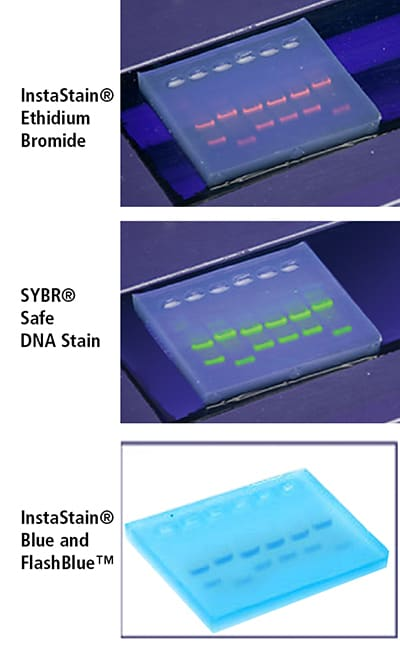 Schematic diagram of DNA staining in agarose gel electrophoresis
Conclusion
GelRed nucleic acid stain represents a safety innovation in nucleic acid staining technology. While maintaining high sensitivity, stability and operational convenience, it significantly reduces experimental toxicity and health risks, providing an ideal alternative to EB for molecular biology laboratories. From conventional PCR analysis to complex genomic research, from teaching laboratories to high-throughput screening platforms, GelRed delivers a safe and reliable nucleic acid visualization solution. With the continuous improvement of laboratory safety standards and the popularization of green chemistry concepts, high-safety nucleic acid stains such as GelRed will become standard configurations in molecular biology experiments, driving the development of nucleic acid electrophoresis technology towards greater safety and environmental protection.
Absin GelRed Nucleic Acid Stain Recommendation:
| Cat. No. | Product Name | Size |
|---|---|---|
| abs9181 | GelRed Nucleic Acid Stain | 1mL/1mL×5 |
Contact Absin
Absin provides antibodies, proteins, ELISA kits, cell culture, detection kits, and other research reagents. If you have any product needs, please contact us.
| Absin Bioscience Inc. worldwide@absin.cn |
 Follow us on Facebook: Absin Bio Follow us on Facebook: Absin Bio |