

- Cart 0
- English
How to efficiently dissociate tissue samples with primary tissue digestion solution?
May 06, 2026
Clicks:73


The rise of organoid culture technology has opened a new avenue for cancer research, drug screening, and regenerative medicine. However, the first step of organoid construction—dissociating solid tissues into viable single cells or cell clusters—often becomes a critical bottleneck restricting experimental success rates. Primary Tissue Digestion Solution, a specially optimized tissue dissociation reagent, provides a reliable solution for rapidly and efficiently obtaining primary cells.
What is Primary Tissue Digestion Solution?
Primary Tissue Digestion Solution is a specially designed enzyme mixture reagent for solid tissue dissociation. It can rapidly and efficiently dissociate tissue samples into cell suspensions or cell clusters for organoid construction. This digestion solution is widely applicable for the digestive dissociation of solid tumors (such as intestinal cancer, lung cancer, breast cancer, endometrial cancer, etc.) and normal tissue specimens for in vitro primary culture.
Unlike traditional single-enzyme digestion protocols using trypsin or collagenase, Primary Tissue Digestion Solution usually contains an optimized combination of multiple proteolytic enzymes. It can specifically degrade components in the extracellular matrix such as collagen, elastin, and fibronectin, while maximally protecting cell surface antigens and viability, laying a solid foundation for subsequent culture.
Why Is Tissue Digestion Critical for Organoid Culture?
Cell viability directly determines organoid success rate. Excessive digestion causes cell membrane rupture and cell death, significantly reducing organoid formation efficiency; insufficient digestion fails to yield enough single cells or cell clusters to meet seeding density requirements. Primary Tissue Digestion Solution balances complete dissociation and cell protection through optimized enzyme activity and reaction time.
Tissue heterogeneity requires personalized treatment. Digestion time varies among different sample types due to tissue origin, tumor subtype, and individual differences. Solid tumors are generally denser than normal tissues and may require prolonged digestion; some soft tissues may need shorter digestion time.
Cell cluster size affects organoid formation. Organoid culture typically requires cell clusters below 70 μm or single-cell suspensions. Overly large cell clusters impair nutrient penetration and metabolic waste excretion, hindering long-term organoid maintenance.
Which Experimental Scenarios Can Be Applied?
Tumor organoid construction is the primary application of Primary Tissue Digestion Solution. Tumor cells are dissociated from patient-derived tumor tissues (e.g., colorectal cancer, non-small cell lung cancer, breast cancer, ovarian cancer) to establish tumor organoid biobanks for drug sensitivity testing, personalized therapy screening, and tumorigenesis mechanism research.
Normal tissue organoid culture is also applicable. Normal tissues such as intestinal epithelium, gastric mucosa, prostate, and mammary gland can be processed with the digestion solution to establish normal organoid models for developmental biology research, toxicology evaluation, and normal-tumor comparative analysis.
Primary cell isolation and culture relies on efficient tissue digestion. Whether for immune cell isolation, stem cell enrichment, or primary tumor cell line establishment, tissues must first be dissociated into single-cell suspensions, and Primary Tissue Digestion Solution provides a standardized dissociation protocol.
Single-cell sequencing sample preparation can use this digestion solution. High-quality single-cell suspensions are prerequisites for successful single-cell RNA sequencing (scRNA-seq). Primary Tissue Digestion Solution yields high-viability, high-yield single-cell suspensions.
In tissue engineering and regenerative medicine research, isolating seed cells from tissues is the primary step. Primary Tissue Digestion Solution provides cell sources for tissue engineering scaffold seeding, 3D bioprinting, and other applications.
How to Use Primary Tissue Digestion Solution Correctly?
Tissue Pre-treatment:
Before digestion, cut the tissue into 1–3 mm³ pieces using ophthalmic scissors or a scalpel. Proper mechanical disruption increases the contact area between tissue and digestion solution to improve efficiency, but avoid excessive shearing that causes cell damage.
Digestion Operation:
Add an appropriate volume of digestion solution (5–10 times the tissue volume) and incubate in a 37°C constant-temperature incubator or shaking incubator. 37°C is the optimal temperature for most proteolytic enzymes, and shaking promotes full contact between enzymes and tissue.
Digestion time varies by sample type, generally 15–30 minutes. Monitor the process carefully, as over-digestion impairs cell viability and drastically reduces organoid success rates.
Digestion Endpoint Judgment:
Examine the digestion suspension microscopically during digestion. Digestion is complete when abundant single cells or cell clusters <70 μm are observed. This is a critical quality control point requiring timely judgment based on experience.
Terminate Digestion:
Add 3 volumes of organoid culture buffer to stop digestion. Serum or specific inhibitors in the termination buffer rapidly neutralize enzyme activity to prevent over-digestion.
Cell Isolation and Washing:
The digested suspension can be directly used for centrifugation or mesh filtration. Wash the sample ≥2 times with organoid buffer before use (centrifugation at 200–300 g for 3 minutes recommended) to remove residual enzymes and cell debris.
Culture Application:
Primary Tissue Digestion Solution is compatible with organoid media. Resuspend the washed cell pellet in organoid medium for 3D culture.
Key Precautions for Use
- Optimize digestion time. Optimal digestion time varies greatly by tissue and tumor subtype; pre-experiments are recommended. The general principle: minimize digestion time while obtaining sufficient single cells/clusters to preserve viability.
- Monitor digestion microscopically. Do not judge endpoints by time alone. Sample and examine microscopically periodically; terminate immediately when abundant single cells or <70 μm clusters appear.
- Avoid over-digestion. Over-digestion drastically reduces cell viability and organoid formation efficiency. Prolonged digestion damages cell membrane integrity, which cannot be rescued by optimized culture conditions.
- Maintain appropriate tissue size. 1–3 mm is recommended. Larger pieces cause incomplete digestion; smaller pieces increase mechanical damage. Reduce size for extremely hard tissues.
- Use sufficient digestion solution. Volume should be 5–10 times the tissue volume to ensure adequate enzyme concentration and unimpeded product diffusion. Insufficient volume reduces efficiency and causes local over-digestion.
- Strict temperature control. 37°C is standard. Low temperatures reduce enzyme activity and prolong digestion; high temperatures damage cells. Use constant-temperature equipment for stability.
- Standard aseptic technique. Primary tissue culture requires strict sterility. Perform all operations in a biological safety cabinet; sterilize instruments and reagents to avoid microbial contamination.
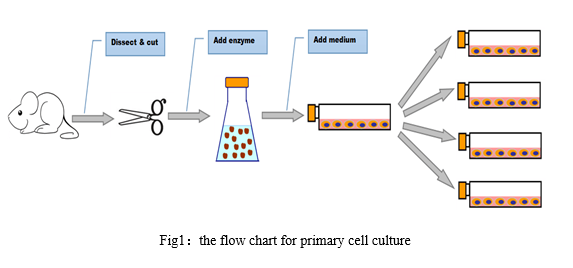
Schematic Diagram of Primary Cell Culture Process
Conclusion
Primary Tissue Digestion Solution is a critical bridge connecting solid tissues and organoid culture. Through optimized enzyme combinations and standardized protocols, it rapidly and efficiently dissociates various solid tissues into viable cell suspensions or clusters, providing high-quality cell sources for cutting-edge technologies including organoid construction, primary cell culture, and single-cell analysis. Mastering proper digestion timing, strict endpoint monitoring, and tissue-specific parameter optimization significantly improves organoid culture success rates and experimental reproducibility. With the widespread application of organoid technology in drug development, precision medicine, and regenerative medicine, standardized tissue digestion protocols will become vital technical support for advancing this field.
Recommended Absin Primary Tissue Digestion Solution:
| Cat. No. | Product Name | Size |
|---|---|---|
| abs9522 | Primary Tissue Digestion Solution | 100mL/500mL |
Contact Absin
Absin provides antibodies, proteins, ELISA kits, cell culture, detection kits, and other research reagents. If you have any product needs, please contact us.
| Absin Bioscience Inc. worldwide@absin.cn |
 Follow us on Facebook: Absin Bio Follow us on Facebook: Absin Bio |