

- Cart 0
- English
How does rat serum play a key role in immunological experiments?
May 06, 2026
Clicks:72


In life science research, serum is an important biological material widely used in immunology, cell culture, and molecular biology experiments. Rat serum has become one of the most commonly used reagents in laboratories due to its stable source, defined composition, and moderate cost. This article will deeply discuss the preparation process, main components, and application value of rat serum in various experiments.
What is Rat Serum?
Rat serum is a biological product prepared from the blood of healthy rats through sterile collection, separation, and microporous filtration. Sprague-Dawley (SD) rats are usually selected as donors, which feature clear genetic background, stable health status, and sufficient blood volume, making them one of the most widely used strains in laboratory animals.
Serum is a pale yellow transparent liquid separated from plasma after removing fibrinogen and some coagulation factors following blood coagulation. Rat serum is a transparent liquid with a light yellow color and a special fishy smell, containing abundant proteins, hormones, growth factors, nutrients, and a variety of biologically active components.
During preparation, sterile collection ensures the avoidance of microbial contamination, separation steps remove blood cells and coagulation factors, and microporous filtration further removes particles and potential pollutants, finally obtaining high-quality serum products meeting experimental requirements.
Why is Rat Serum Suitable as an Experimental Material?
Uniform genetic background. As an inbred strain, SD rats have a relatively uniform genetic background, small individual differences, and good inter-batch stability, which is conducive to the repeatability of experimental results.
Rich and stable composition. Rat serum contains albumin, globulin, complement system components, various growth factors and hormones, which play important roles in cell culture, immune reactions, and biochemical reactions.
Moderate immunogenicity. Compared with fetal bovine serum, rat serum has lower immunogenicity and can reduce non-specific reactions in immune experiments; compared with mouse serum, rats are larger in size with more blood collected at a single time, suitable for large-scale experimental needs.
Balanced cost-effectiveness. The price of rat serum is usually lower than fetal bovine serum but higher than rabbit or goat serum, achieving a good balance between performance and cost, suitable for routine experiments.
Which Experimental Scenarios Can Be Applied?
Animal immunization experiments are one of the basic applications of rat serum. In the process of preparing polyclonal or monoclonal antibodies, rat serum can be used as negative control serum for immunized animals to evaluate the baseline antibody level before immunization. Meanwhile, the immunoglobulin (IgG) component in rat serum can also be used as a control for antibody purification and identification.
Serum IgG preparation is another important application. Rat serum is rich in IgG, which can be separated and purified by protein A/G affinity chromatography, ammonium sulfate precipitation, and other methods. The obtained rat IgG can be used as a negative control for IHC, Western Blot, or as a standard for antibody quantification.
Pathological histochemistry blocking is the core application of rat serum. In immunohistochemistry (IHC) and immunofluorescence (IF) experiments, tissue sections or cell slides need to be blocked with serum before adding the primary antibody. Proteins in rat serum can non-specifically bind to Fc receptors and charged sites on tissue sections, block non-specific binding of primary or secondary antibodies, significantly reduce background staining, and improve the signal-to-noise ratio.
ELISA blocking is also applicable. In enzyme-linked immunosorbent assay, microplates coated with antigens or antibodies need to be treated with blocking solution to prevent non-specific binding of detection antibodies to the plate surface. As a natural protein mixture, rat serum can effectively block the remaining binding sites on the plate and reduce false positive results.
Immunoassay protectant function cannot be ignored. In some immune detection systems, rat serum can be added to diluents or washing solutions as a protectant to maintain protein stability and activity, preventing inactivation or degradation of antibodies or antigens during operation.
Cell culture supplementation can also be used under specific conditions. Although fetal bovine serum is the mainstream choice for cell culture, rat serum can be used as an alternative or supplement in some special cell lines or experimental designs, especially when studying rat-derived cells or avoiding interference from bovine components.
In tissue block preservation, rat serum can be used as a protective medium. During short-term preservation or transportation of tissue samples, soaking in serum-containing buffer can maintain tissue activity and reduce cell damage.
How to Use Rat Serum Correctly?
Blocking experiment operation:
In IHC or IF experiments, after antigen retrieval and permeabilization, add an appropriate amount of rat serum (usually 1%-10% concentration diluted with PBS) to tissue sections or cell slides, and incubate at room temperature for 30-60 minutes. After blocking, remove excess serum and add the diluted primary antibody directly without washing.
ELISA blocking operation:
After coating the microplate with antigen or antibody, add 200 μL/well of rat serum (usually 1%-5% concentration diluted with PBS or carbonate buffer), incubate at 37°C for 1-2 hours or overnight at 4°C. After blocking, discard the blocking solution, wash the plate 3 times with washing buffer, and then add the detection antibody.
Serum IgG extraction:
Using protein A/G affinity chromatography, incubate rat serum with protein A/G beads. After specific binding of IgG, elute with low pH buffer to obtain purified rat IgG. Ammonium sulfate fractional precipitation can also be used, and 50% saturation can precipitate most IgG.
Key Precautions for Use
- Avoid repeated freeze-thaw cycles. Proteins in serum are temperature-sensitive, and repeated freeze-thaw cycles will lead to protein denaturation, precipitation, and loss of activity. It is recommended to aliquot the serum into small portions according to experimental usage after receipt, store at -20°C or -80°C, take one portion each time to avoid repeated freezing and thawing.
- Sterile operation. Although the serum has been sterile filtered, sterile operation should be noted after opening to avoid microbial contamination. Aliquoting and usage should be performed in a biological safety cabinet or clean bench.
- Concentration optimization. Different experiments have different requirements for serum blocking concentration, and pre-experiments are recommended for optimization. Too low a concentration may lead to insufficient blocking and high background; too high a concentration may increase non-specific binding or affect antigen-antibody reactions.
- Batch consistency. There may be compositional differences between different batches of rat serum. It is recommended to use the same batch of serum for the same experiment, or verify batch consistency before use.
- Cross-reactivity assessment. When using rat serum for blocking, cross-reactivity with the detection antibody should be considered. If the secondary antibody is derived from rats (e.g., anti-rat IgG), rat serum is not suitable as a blocking agent to avoid interfering with detection.
- Storage conditions. Unopened serum should be stored below -20°C and protected from light. Thaw slowly at 4°C or at room temperature naturally, avoiding rapid thawing in a 37°C water bath which causes protein denaturation.
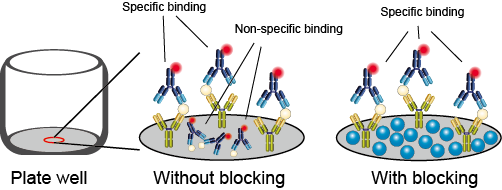
Schematic Diagram of ELISA Blocking Principle
Conclusion
As a classic biological reagent, rat serum plays an irreplaceable role in immunological research, pathological diagnosis, and cell biology experiments. From blocking in IHC to quality control in ELISA, from antibody purification to cell culture, the application of rat serum runs through many fields of life science. Correctly understanding its compositional characteristics, mastering usage methods and precautions will ensure the accuracy and repeatability of experimental results. With the development of precision medicine and translational medicine, the standardized production and application of high-quality laboratory animal serum will further promote the transformation of basic research results into clinical applications.
Recommended Absin Rat Serum:
| Cat. No. | Product Name | Size |
|---|---|---|
| abs947 | Rat Serum | 100mL |
Contact Absin
Absin provides antibodies, proteins, ELISA kits, cell culture, detection kits, and other research reagents. If you have any product needs, please contact us.
| Absin Bioscience Inc. worldwide@absin.cn |
 Follow us on Facebook: Absin Bio Follow us on Facebook: Absin Bio |