

- Cart 0
- English
How does the polyethylene glycol-polyvinyl alcohol composite support fragile tissues in frozen sections?
April 29, 2026
Clicks:71


In histopathology and molecular biology research, maintaining the integrity of tissue morphology and structure is a prerequisite for obtaining accurate diagnostic and experimental data. For samples requiring enzyme activity preservation, lipid retention, or rapid pathological diagnosis, frozen sectioning is superior to paraffin embedding. OCT Compound (Optimal Cutting Temperature Compound), a water-soluble viscous liquid composed of polyethylene glycol (PEG) and polyvinyl alcohol (PVA), provides a rigid supporting matrix for tissues at low temperatures through its unique physicochemical properties. It effectively solves the problems of tissue fragmentation, wrinkling, and ice crystal damage during frozen sectioning, making it the standard medium for frozen section technology.
Why Does the Water-Soluble Embedding Medium Avoid Background Staining Interference?
Unlike organic solvents (xylene, ethanol) used in paraffin embedding, OCT Compound is completely water-soluble, bringing significant advantages to subsequent experiments:
No Residual Interference:
After sectioning, OCT can be completely dissolved and removed by simple rinsing in water, leaving no hydrophobic substances in the tissue. This is critical for immunohistochemistry (IHC) and immunofluorescence (IF) staining—paraffin sections require xylene dewaxing, which may damage heat-sensitive antigens or introduce organic solvent background, while OCT sections can be directly hydrated for staining without dewaxing.
Zero Background Staining:
As OCT consists of inert polyethylene glycol and polyvinyl alcohol, it contains no proteins or other components that may bind antibodies, and does not increase non-specific background staining during subsequent procedures. This results in a higher signal-to-noise ratio and clearer results for the detection of low-abundance antigens.
Antigenicity Protection:
Water-soluble embedding avoids the destruction of tissue epitopes by organic solvents, making it particularly suitable for experiments detecting heat-sensitive or organic solvent-labile antigens.
Which Experimental Steps Best Demonstrate the Supporting Value of OCT?
Rapid Frozen Sectioning of Fresh Tissues
Time is critical for intraoperative rapid pathological diagnosis (e.g., tumor surgical margin assessment). Fresh tissues must undergo OCT embedding and sectioning within 30 minutes after resection. OCT rapidly solidifies on a freezing platform (-25°C to -30°C) within 10–20 minutes to form a hard white solid block, immediately supporting the tissue for micron-level sectioning to meet the time requirements of rapid diagnosis.
Immunohistochemistry and Immunofluorescence
Tissue sections embedded in OCT can be directly incubated with antibodies without dewaxing, maximally preserving the natural antigenicity of tissues. This is especially important for detecting antigens sensitive to processing, such as nuclear and membrane proteins. Sections can be stored long-term at -20°C or -80°C and retrieved for staining at any time.
Lipid and Nerve Tissue Preservation
Organic solvents (e.g., xylene, ethanol) in paraffin embedding dissolve lipid components in tissues, while OCT embedding uses an aqueous environment throughout, fully preserving lipids, nerve myelin sheaths, and other structures easily dissolved by organic solvents. It is an ideal choice for neuroscience and lipid metabolism research.
Enzyme Activity Detection
For experiments requiring detection of tissue enzyme activity (e.g., enzyme histochemistry), frozen sections avoid enzyme inactivation caused by high temperature (60°C) in paraffin embedding. Samples snap-frozen and preserved after OCT embedding can be directly used for enzyme activity localization assays.
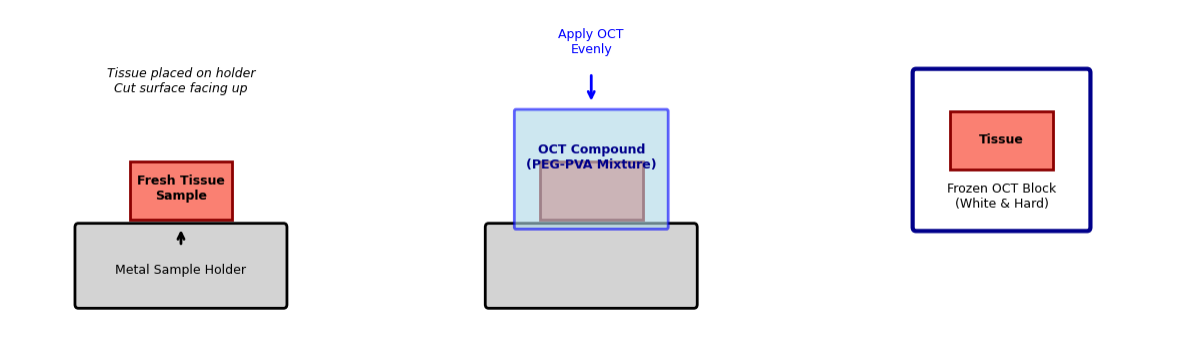
Figure: Schematic diagram of the OCT embedding procedure. Left: Fresh tissue sample is placed on a metal specimen chuck with the cut surface facing up. Middle: OCT compound (PEG-PVA mixture) is added dropwise to evenly cover the tissue. Right: A white hard OCT embedding block formed after rapid freezing on a freezing platform (10–20 minutes), ready for serial sectioning.
How to Optimize Embedding for High-Quality Sections?
Key Points of Tissue Preprocessing
- Fresh Tissue: Process within 30 minutes after resection. Gently blot surface moisture with filter paper (avoid excessive drying) and immediately perform OCT embedding.
- Tissues Stored at -80°C: Thaw slowly at -20°C for half an hour in advance to avoid ice crystal formation and tissue damage caused by sudden temperature changes.
- Fixed Tissue: Tissues fixed with 4% paraformaldehyde must be dehydrated with 15–30% sucrose solution (to prevent ice crystal formation) and sink to the bottom before OCT embedding.
Critical Control Points for Embedding
- Avoid Bubbles: Add OCT slowly and evenly to prevent bubbles. Bubbles cause section breakage or incompleteness. If bubbles exist in the reagent bottle, eliminate them by standing or centrifugation before use.
- Complete Coverage: Fully surround the tissue with OCT embedding medium to ensure complete encapsulation and formation of a continuous supporting matrix.
- Section Orientation: Pay attention to the position of the cut surface and embedding orientation during embedding to ensure the target observation area lies within the section plane and avoid missing the target region.
- Flash Freezing Temperature: Place the specimen chuck on a freezing platform (-25°C to -30°C) or dry ice for rapid freezing. Sectioning can be performed once OCT turns white and hard (about 10–20 minutes). Slow freezing forms large ice crystals that destroy tissue structure.
Sectioning and Storage
- Section Thickness: Usually 5–20 μm, adjusted according to tissue type. 20–30 μm for brain tissue, 5–10 μm for tumor tissue.
- Mounting: Mount sections on positively charged or coated adhesive slides to prevent detachment during washing.
- Storage: Use sections immediately after air-drying, or seal and store at -20°C (short-term) or -80°C (long-term). Remaining OCT blocks can be labeled and stored frozen at -80°C for future use.
Conclusion
With its water-soluble PEG-PVA composite formula, OCT Compound achieves a perfect balance of tissue support and staining compatibility in frozen sectioning. From intraoperative rapid diagnosis to precise immunofluorescence localization, from lipid preservation to enzyme activity detection, OCT embedding provides indispensable technical support for modern pathology and life science research. Mastering the correct timing of embedding, flash freezing techniques, and orientation control is the key to obtaining high-quality frozen sections and ensuring accurate experimental data.
Absin OCT Embedding Compound
| Cat. No. | Product Name | Size |
|---|---|---|
| abs9756 | OCT Embedding Compound | 110mL |
Contact Absin
Absin provides antibodies, proteins, ELISA kits, cell culture, detection kits, and other research reagents. If you have any product needs, please contact us.
| Absin Bioscience Inc. worldwide@absin.cn |
 Follow us on Facebook: Absin Bio Follow us on Facebook: Absin Bio |