

- Cart 0
- English
How do three pairs of disulfide bonds maintain the active conformation of the only hypoglycemic hormone?
April 29, 2026
Clicks:75


Among the hormone families that maintain metabolic homeostasis, insulin holds an irreplaceable position—it is the only known hormone in the body that lowers blood glucose. This polypeptide hormone, secreted by pancreatic beta cells, forms a compact protein structure with a molecular weight of approximately 5800 Da through the precise arrangement of 51 amino acid residues and spatial stabilization by three pairs of disulfide bonds. Bovine insulin extracted from bovine pancreas, although with minor differences in amino acid sequence compared to human insulin, is highly conserved in biological function and plays a crucial role in cell culture, metabolic regulation research, and biochemical analysis.
How Does the Double-Chain Structure Maintain Biological Activity via Disulfide Bonds?
Bovine insulin is a typical polypeptide hormone, and its structural characteristics reflect the close relationship between protein structure and function:
Double-chain composition:
Insulin consists of two polypeptide chains—the A chain (α chain, 21 amino acids) and the B chain (β chain, 30 amino acids). The two chains are covalently linked by two interchain disulfide bonds (A7-B7 and A20-B19), forming a stable heterodimeric structure. In addition, an intrachain disulfide bond (A6-A11) exists within the A chain, further stabilizing the spatial conformation of the A chain.
Key roles of disulfide bonds:
These three pairs of disulfide bonds are not only "molecular bridges" connecting the two peptide chains but also essential for maintaining the three-dimensional structure and biological activity of insulin. Breakage or mispairing of disulfide bonds leads to insulin inactivation, explaining why insulin is sensitive to reducing agents (such as β-mercaptoethanol) and extreme pH.
Species differences:
Insulin from different species (bovine, porcine, human) shares largely identical functions, with the main difference lying in amino acid 30 of the B chain (alanine in bovine, threonine in human). This minor sequence variation does not affect its receptor-binding capacity or biological activity, making bovine insulin an excellent source for research and applications.
Why Is Acidic Solubility a Critical Control Point for Preparation?
The solubility properties of bovine insulin are closely related to its isoelectric point and molecular structure, which directly impact experimental operations:
pH-dependent solubility:
Bovine insulin is nearly insoluble in water at neutral pH (pH 7.0) but highly soluble under acidic conditions (pH 2.0–3.0). This is because the isoelectric point of insulin is approximately 5.3–5.4; under acidic conditions, it carries a positive charge, increasing intermolecular electrostatic repulsion and enhancing solubility. 0.1 mol/L HCl is required as a solvent to adjust the pH to 2.0–3.0 when preparing stock solutions.
Risks of extreme acidity:
Although acidic conditions facilitate dissolution, insulin may undergo amide bond hydrolysis or disulfide exchange reactions under extreme acidity (pH < 2.0), resulting in degradation and inactivation. Therefore, precise pH control is necessary during preparation to avoid over-acidification.
Alkaline solubility:
Insulin is also soluble in alkaline solutions (e.g., dilute ammonia water), but denaturation occurs more readily under alkaline conditions; thus, the acidic preparation protocol is generally recommended.
Which Experimental Scenarios Best Reflect Its Biological Activity Value?
Growth Supplement for Cell Culture
Insulin is a standard additive in most mammalian cell culture media, with a recommended working concentration of 10 μg/mL. Its mechanisms of action include:
Promotion of glucose uptake:
Insulin binds to the cell surface insulin receptor (IR), activating the PI3K/Akt signaling pathway, promoting the translocation of GLUT4 glucose transporters to the cell membrane, and increasing glucose uptake to provide energy for cells.
Stimulation of amino acid transport:
Insulin enhances cellular uptake of amino acids, promotes protein synthesis, and supports cell proliferation and growth.
Regulation of lipid metabolism:
Insulin promotes fatty acid synthesis and triglyceride storage, inhibits lipolysis, and provides lipid building blocks for cells.
Promotion of glycogen synthesis:
In hepatocytes and myocytes, insulin activates glycogen synthase and promotes the conversion of glucose into stored glycogen.
Metabolic Regulation and Signal Transduction Research
As a classic metabolic hormone, insulin is widely used for:
- Insulin resistance research: Establishing cellular models of type 2 diabetes to study abnormalities in the insulin signaling pathway
- Metabolic syndrome mechanisms: Exploring the molecular basis of metabolic disorders such as obesity and hyperlipidemia
- Cell differentiation induction: Insulin is an essential factor for inducing differentiation in certain cell lines (e.g., adipocyte precursor 3T3-L1)
Biochemical Standard
High-purity bovine insulin (≥27 USP units/mg) can be used as:
- Molecular weight standard for protein electrophoresis (~5.8 kDa)
- Standard for insulin radioimmunoassay (RIA)
- Substrate or control for enzyme activity assays
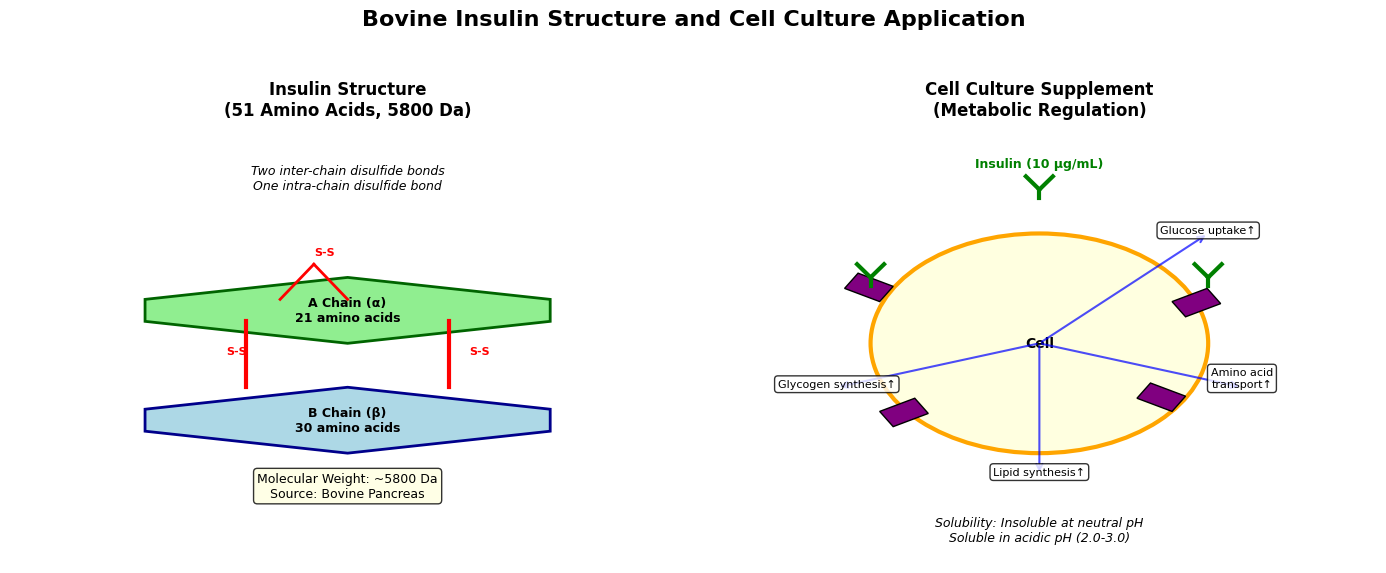
Figure: Schematic diagram of bovine insulin structure and applications. The left panel shows the double-chain structure of insulin (A chain: 21 amino acids, green; B chain: 30 amino acids, blue), linked by two interchain disulfide bonds (red) and one intrachain disulfide bond in the A chain, with a molecular weight of approximately 5800 Da. The right panel illustrates the mechanism of insulin as a cell culture supplement: insulin (10 μg/mL) binds to cell membrane receptors, promoting glucose uptake, amino acid transport, glycogen synthesis, and lipid synthesis.
How to Prepare and Store Correctly to Maintain Activity?
Stock Solution Preparation Steps
- Weighing and dissolution: Weigh 10 mg of bovine insulin powder and add it to 1 mL of 0.1 mol/L HCl. Insulin is insoluble in neutral water, so an acidic solvent is mandatory.
- pH adjustment: Fine-tune the pH to 2.0–3.0 using dilute hydrochloric acid or sodium hydroxide solution. This pH range ensures solubility while avoiding degradation caused by extreme acidity.
- Solubility confirmation: Magnetically stir or vortex mix at room temperature for 10–30 minutes to ensure complete dissolution. The solution should be colorless and transparent without insoluble particles.
- Sterile filtration: Filter-sterilize using a low protein-binding membrane (e.g., PVDF membrane, 0.22 μm), or add 0.1% thimerosal or sodium azide as a bacteriostatic agent.
Storage Conditions
- Aliquot and freeze: Aliquot the stock solution into sterile EP tubes at single-use volumes to avoid repeated freeze-thaw cycles. Store long-term at -20°C and short-term (within 6 months) at 2–8°C.
- Avoid repeated freeze-thaw: Repeated freeze-thaw cycles promote protein aggregation and activity loss. Aliquot into small portions (e.g., 100–200 μL) and use one tube per experiment.
- Protect from light: Insulin is light-sensitive; all operations should be performed in the dark, and storage containers should be amber bottles or wrapped in aluminum foil.
Usage Precautions
- Temperature control: Maintain room temperature (20–25°C) during operation; avoid high temperatures (>37°C) that cause protein denaturation.
- Sterile operation: Use aseptic techniques and sterile reagents to prevent microbial contamination. Insulin is nutrient-rich and prone to bacterial growth.
- Working solution preparation: Dilute the stock solution to the working concentration (usually 10 μg/mL) with medium or buffer immediately before use.
- Avoid mixing with alkaline reagents: When adding to cell culture medium, add dropwise and mix gently to prevent precipitation caused by locally high pH.
How to Evaluate Insulin Activity?
Biological activity unit:
Insulin activity is typically expressed in USP units (United States Pharmacopeia units). High-purity bovine insulin should be ≥27 USP units/mg. 1 USP unit is approximately equivalent to 0.0417 mg of international standard insulin.
In vitro activity assay:
Biological activity can be evaluated via adipocyte glucose oxidation assays or cardiomyocyte glycogen synthesis assays.
Physicochemical property confirmation:
Purity is detected by SDS-PAGE, molecular weight and purity are analyzed by HPLC, and molecular weight and sequence are confirmed by mass spectrometry.
Conclusion
With its unique double-chain, three-disulfide bond structure and exclusive hypoglycemic biological function, bovine insulin has become an indispensable reagent in metabolic research and cell culture. From the spatial conformation maintained by precise disulfide bonds, to pH-dependent solubility properties, to comprehensive regulation of cellular metabolism, bovine insulin demonstrates the perfect unity of protein structure and function. Mastering key control points such as acidic dissolution, light-protected storage, and sterile operation is crucial to ensuring the biological activity of insulin and obtaining reliable experimental results.
Absin Bovine Insulin Recommendation
| Cat. No. | Product Name | Size |
|---|---|---|
| abs9169 | Insulin from Bovine Pancreas | 25mg/100mg/500mg/1g |
Contact Absin
Absin provides antibodies, proteins, ELISA kits, cell culture, detection kits, and other research reagents. If you have any product needs, please contact us.
| Absin Bioscience Inc. worldwide@absin.cn |
 Follow us on Facebook: Absin Bio Follow us on Facebook: Absin Bio |