

- Cart 0
- English
The Secret of "Starvation-Resistant" Tumor Cells Cracked! BAG2-SAMD4B Axis Unlocks Novel Arginine Sensing Mechanism
April 15, 2026
Clicks:81


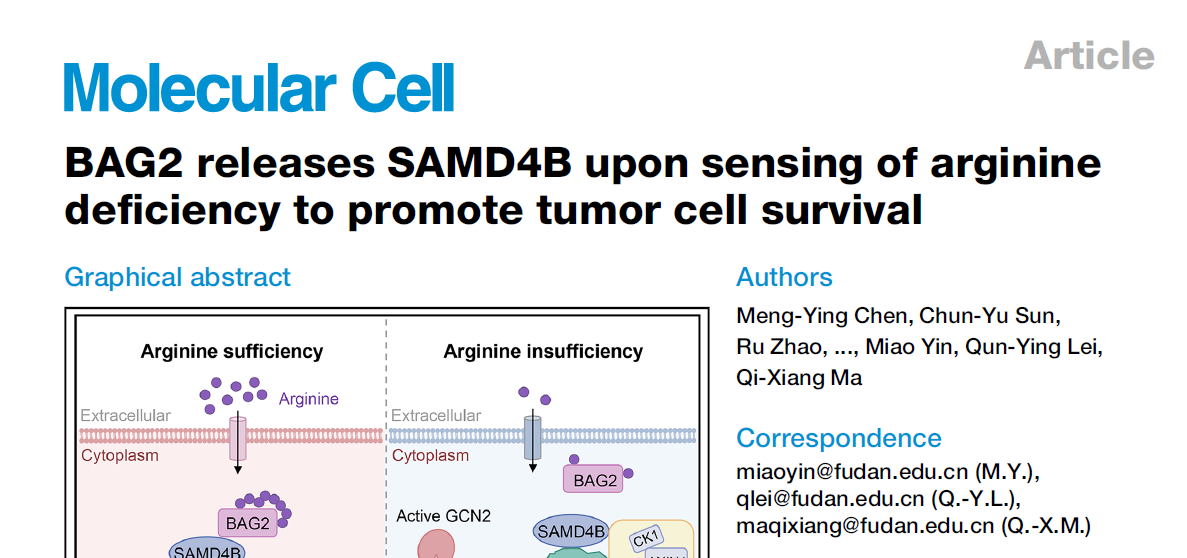
A groundbreaking study published in Molecular Cell reveals for the first time that BAG2 functions as an arginine sensor, promoting tumor cell survival under nutritional stress through regulation of the SAMD4B-β-catenin signaling pathway. This discovery provides a novel therapeutic target for metabolic targeting strategies in cancer treatment, with Absin mIHC kits playing a pivotal role throughout the research.
Title: BAG2 releases SAMD4B upon sensing of arginine deficiency to promote tumor cell survival
Journal: Molecular Cell (IF 16.6) | DOI: https://doi.org/10.1016/j.molcel.2025.05.035
Absin Product Used: Four-Color Multiplex Fluorescence Immunohistochemistry Staining Kit (Mouse/Rabbit Universal Secondary Antibody) (abs50012)

I. Research Strategy: Unraveling the Arginine Sensing Mechanism through Progressive Investigation
The rapid proliferation of tumor cells depends on adequate nutrient supply. Arginine, as a conditionally essential amino acid, has metabolic dysregulation closely associated with tumor progression. Previous studies have shown that certain tumors exhibit defects in arginine biosynthetic enzymes and rely on exogenous arginine for survival; however, how cells sense arginine deficiency and initiate adaptive mechanisms remains incompletely understood.
The research team employed a progressive "screening-validation-mechanistic analysis" approach:
- 1. Initial compound library screening identified the Wnt/β-catenin pathway as a critical regulator of cell survival under arginine deprivation;
- 2. Genome-wide CRISPR screening and proteomic mass spectrometry analysis identified SAMD4B as a core regulator of β-catenin degradation;
- 3. Arginine affinity probe combined with interactome screening identified BAG2 as a direct arginine-binding sensor;
- 4. Finally, in vitro biochemical assays, cellular functional validation, and animal models were utilized to fully elucidate the BAG2-SAMD4B-β-catenin-ATF4 signal transduction pathway.
II. Core Research Findings: Non-canonical Pathway of Arginine Sensing
1. BAG2: A Novel Arginine Sensor
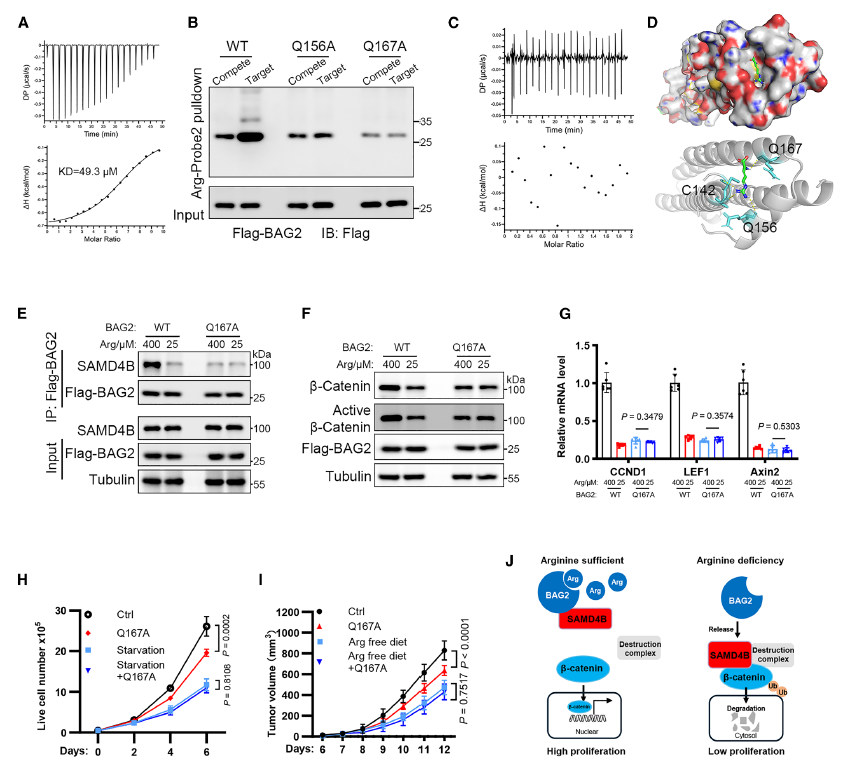
The study confirmed that BAG2 directly binds arginine through glutamine residue Q167, forming a tight complex with SAMD4B under arginine-replete conditions; upon arginine depletion, BAG2 releases SAMD4B, initiating downstream signaling (Figure 6D). This represents the first discovery of BAG2's nutrient-sensing function, challenging the traditional perception of BAG2 solely as a molecular chaperone regulator.
2. SAMD4B Mediates β-Catenin Degradation
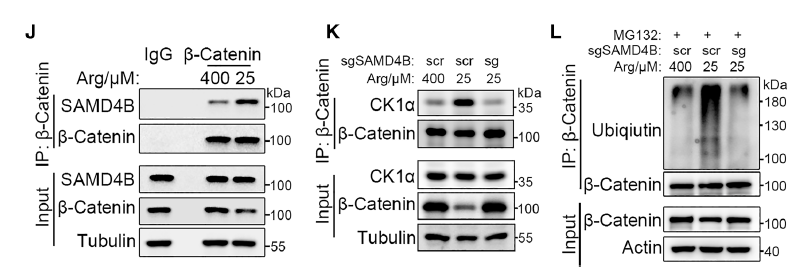
Released SAMD4B directly binds β-catenin and degradation complex components (CK1α, GSK3β), promoting β-catenin phosphorylation and ubiquitin-mediated proteolysis (Figure 3J, 3L). Under arginine-replete conditions, BAG2-mediated inhibition of SAMD4B stabilizes β-catenin, activating the Wnt pathway to support cellular proliferation.
3. Dual Pathway Synergy in Cell Survival Regulation
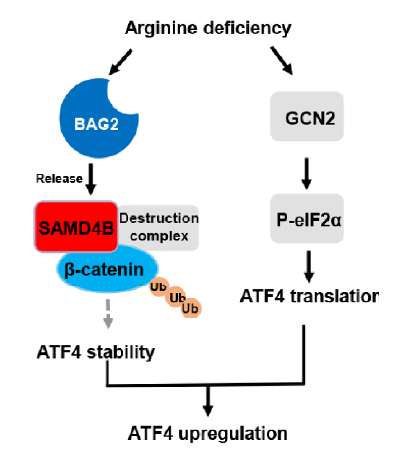
Under arginine deprivation, the BAG2-SAMD4B axis stabilizes ATF4 through β-catenin degradation, synergistically activating the integrated stress response (ISR) with the canonical GCN2-eIF2α pathway, thereby facilitating tumor cell adaptation to nutrient-scarce environments (Figure 7I). This mechanism explains why certain tumors develop resistance to arginine deprivation therapy.
III. Absin mIHC Kit: Critical Enabler of Experimental Success
In this multi-technique interdisciplinary study, Absin's Four-Color Multiplex Fluorescence Immunohistochemistry Staining Kit (Cat. No.: abs50012) played an irreplaceable role, providing essential support for the visualization and validation of core mechanisms.
Product Application Scenarios
| Detection Marker Combination | Marker Type | Marker Function and Detection Purpose |
|---|---|---|
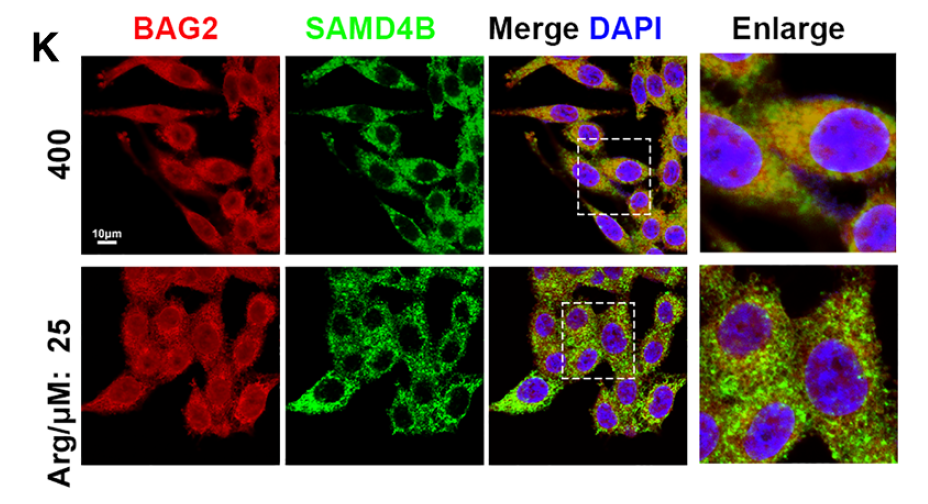
| BAG2 + SAMD4B | Core Signaling Proteins | 1. Validate intracellular co-localization regions of BAG2 and SAMD4B (cytoplasm); 2. Compare dynamic changes in binding intensity between arginine-replete and arginine-deficient conditions |
| DAPI | Nuclear Counterstain | Nuclear region localization, exclusion of intranuclear signal interference, confirmation that BAG2-SAMD4B interaction occurs in the cytoplasm (Figure 5K) |
Key Product Features
- 1. Overcoming Antibody Species Limitations: Supports multiplex labeling of primary antibodies from the same species without cross-reactivity concerns, perfectly suited for BAG2 and SAMD4B co-localization detection;
- 2. High Signal Specificity: The kit employs optimized fluorescence labeling systems and signal amplification technology, effectively reducing background noise and presenting clear protein localization signals;
- 3. Convenient and Efficient Operation: Standardized experimental protocols minimize operational errors, enabling rapid acquisition of high-resolution imaging results with confocal microscopy, providing direct visual evidence for mechanistic validation.
IV. Research Significance and Future Perspectives
This study not only reveals a non-canonical pathway of arginine sensing, providing a novel research direction for the field of tumor metabolism, but also holds significant clinical implications. Targeted intervention against the BAG2-SAMD4B axis holds promise for enhancing the anti-tumor efficacy of arginine deprivation therapies (such as ADI-PEG20) and overcoming drug resistance challenges.
Absin remains committed to providing high-quality experimental tools for researchers. In addition to multiplex immunofluorescence kits, we offer a comprehensive product portfolio encompassing antibodies, fluorescent probes, cell function assay kits, and more, meeting diverse research needs in oncology, metabolic biology, and related fields. Moving forward, Absin will continue to support cutting-edge research, providing solid foundations for breakthroughs in life sciences.
This article is based on the original publication in Molecular Cell (DOI: 10.1016/j.molcel.2025.05.035); all original figures, data, and intellectual property rights belong to the original journal and research team. Should any infringement occur, please contact us promptly for removal, and we will actively cooperate in addressing such matters.
Contact Absin
Absin provides antibodies, proteins, ELISA kits, cell culture, detection kits, and other research reagents. If you have any product needs, please contact us.
| Absin Bioscience Inc. worldwide@absin.cn |
 Follow us on Facebook: Absin Bio Follow us on Facebook: Absin Bio |