

- Cart 0
- English
Why Does Single-Component TMB Chromogen Become the Preferred Substrate for HRP Detection Systems?
March 23, 2026
Clicks:3234


3,3',5,5'-Tetramethylbenzidine (TMB) is one of the most commonly used chromogenic substrates for Horseradish Peroxidase (HRP) catalytic reactions. Compared to other chromogenic substrates such as o-Phenylenediamine (OPD), TMB offers higher sensitivity and is non-carcinogenic, making it widely applicable in Enzyme-Linked Immunosorbent Assay (ELISA), immunodot blot, immunohistochemistry (IHC), and membrane blotting experiments (Western Blot, Southern Blot, Northern Blot). Traditional TMB chromogenic reagents typically consist of multiple components that must be prepared on-site before use, which is not only operationally cumbersome but also prone to precipitation, leading to unstable detection results. Single-component TMB chromogen employs innovative formulation technology, pre-mixing TMB substrate, hydrogen peroxide (H₂O₂), and stabilizers into a single solution, enabling ready-to-use application, significantly simplifying experimental workflows, and improving reproducibility and reliability of detection results.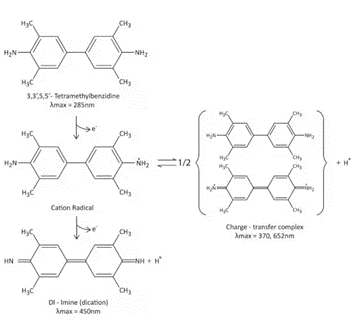
What Is the Chemical Principle of TMB Chromogenic Reaction?
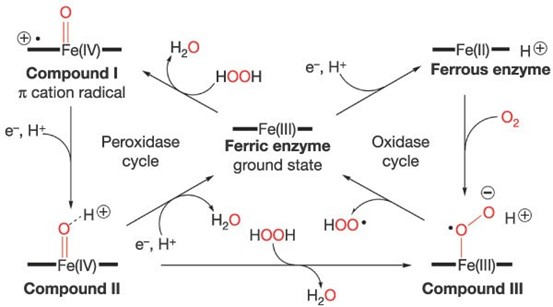
The TMB chromogenic reaction is based on the catalytic cycle mechanism of HRP. HRP is a heme-containing redox enzyme that, in the presence of hydrogen peroxide (H₂O₂), can catalyze the oxidation of TMB.
Chromogenic Process:
1. Blue Product Formation: HRP catalyzes the loss of electrons from TMB, forming a cation radical, which is further oxidized to generate a charge-transfer complex, presenting as a soluble blue color with maximum absorbance at 370 nm (some literature reports an absorption peak at 650 nm as well)
2. Acid Termination and Yellow Product: Upon addition of acidic stop solution (such as 0.5-2M H₂SO₄, 0.5M HCl, or 1M H₃PO₄), the blue product becomes protonated and transforms into a di-imine (dication), changing color from blue to yellow with maximum absorbance shifting to 450 nm
Quantitative Advantages:
- The blue phase (370 nm) is suitable for rapid qualitative observation or kinetic detection without termination
- The yellow phase (450 nm) has a higher extinction coefficient and is the standard detection wavelength for quantitative ELISA, with the yellow product remaining stable for 30 minutes, facilitating batch reading
What Are the Advantages of Single-Component vs. Multi-Component TMB Reagents?
Traditional multi-component TMB reagents typically store the substrate (TMB) and oxidant (H₂O₂) separately, requiring proportional mixing before use. This approach has significant drawbacks: the preparation process may introduce bubbles, uneven mixing leads to inconsistent color development, and precipitation is prone to occur, affecting photometric determination.
Technical Breakthroughs of Single-Component TMB:
Operational Simplification
No preparation required; ready to use directly, avoiding manual operational errors
High Stability
Pre-mixed formulation maintains component compatibility through special stabilizers, with extended shelf life under 2-8°C protected from light
Reliable Results
Eliminates precipitation issues caused by improper preparation, significantly reducing inter-well variation (CV values)
Efficiency Enhancement
Particularly suitable for High-Throughput Screening (HTS) and automated workstations; 100 mL can detect approximately 1,000 ELISA samples
How to Differentiate Applications of Different Types of Single-Component TMB Chromogens?
Based on differences in sensitivity and application scenarios, single-component TMB chromogens are classified into multiple specifications; incorrect selection may result in overly strong or weak signals:
Standard/Regular Type
Suitable for routine ELISA quantitative analysis, featuring a wide linear range and low background characteristics. Room temperature color development time is typically 10-30 minutes, or 10-30 minutes at 37°C, suitable for most routine detections.
Super Sensitive Type
Specifically designed for detecting low-abundance antigens or weak antibody reactions. Offers the highest color development efficiency among TMB substrate series, producing obvious blue signals within 2-10 minutes. Recommended for:
- Qualitative detection (such as antibody screening, positive clone identification)
- ELISA detection of low-expression proteins
- Rapid detection workflows requiring shortened color development time
Broad Range Type
Optimized for dynamic detection range, capable of detecting both high and low concentration samples simultaneously without easy saturation. Particularly suitable for:
- Quantitative ELISA analysis
- Precise quantitative experiments requiring standard curve establishment
- Batch detection with large sample concentration differences
Membrane Blotting Dedicated Type
Specifically designed for membrane immunodetection experiments such as Western Blot, dot blot, Southern Blot, and Northern Blot. Unlike ordinary soluble TMB, the membrane-dedicated type produces purple insoluble precipitate at reaction sites, with extremely low or no background, and can be terminated directly with water (no strong acid required), avoiding damage to nitrocellulose or PVDF membranes from strong acids.
How to Establish a Standardized ELISA Chromogenic Operation Workflow?
Preparation:
- Remove single-component TMB chromogen from 2-8°C refrigerator and equilibrate to room temperature (if containing glycerol components, warm in 37°C water bath until liquid state)
- Ensure chromogen is clear and colorless; if turbidity or blue color appears indicating oxidation and failure, discontinue use
Operation Steps:
1. Thorough Washing
After HRP-labeled antibody incubation, wash with PBST (PBS containing Tween-20) or TBST 3-5 times, 3-5 minutes each, to completely remove unbound enzyme-labeled antibody (this is key to reducing background)
2. Add Chromogen
Remove wash solution, add 100 μL single-component TMB chromogen per well
3. Protected from Light Incubation
Incubate at room temperature (20-37°C) protected from light for 5-30 minutes, or extend up to 24 hours according to experimental requirements, until color develops to expected intensity (blue)
Note: Color development time needs optimization based on antigen-antibody affinity; excessive development (>30 minutes) may lead to increased background
4. Reading or Termination
- Direct Reading: Measure absorbance at 370 nm wavelength (suitable for kinetic analysis)
- Terminated Reading: Add 100 μL 0.5-2M H₂SO₄ to terminate reaction; color changes from blue to yellow, measure absorbance at 450 nm (recommended to complete reading within 30 minutes after termination to avoid yellow product degradation)
In Which Experiments Can Single-Component TMB Chromogen Be Applied?
Enzyme-Linked Immunosorbent Assay (ELISA):
- Antigen/hapten quantitative detection (such as cytokines, hormones, pathogen proteins)
- Antibody titer determination (such as vaccine immunization efficacy evaluation)
- Positive clone identification in drug screening and antibody drug development
Membrane Blotting Immuno-detection:
- Western Blot: Qualitative detection of protein expression; TMB chromogenic bands can be preserved long-term (photographic documentation), no darkroom or film required
- Dot Blot: Rapid screening of positive clones or detection of nucleic acid/protein samples
- Southern/Northern Blot: HRP chromogenic detection after nucleic acid hybridization
Histochemistry:
HRP chromogenic detection in immunohistochemistry (IHC) for localization observation of specific proteins in tissue sections
Key Precautions and Frequently Asked Questions in Use
Safety Protection:
- Single-component TMB chromogen contains TMB and H₂O₂, which are irritating to skin and mucous membranes
- Laboratory coat, disposable gloves, and protective eyewear must be worn during operation
- In case of accidental skin contact, immediately rinse with copious amounts of water
Chromogenic Control:
- High Background: Check if blocking is sufficient (recommend 5% skim milk or BSA), if washing is thorough, and if secondary antibody concentration is too high
- No Color or Weak Color: Check if HRP-labeled antibody is inactivated, if chromogen has failed (turned blue or turbid), or if color development time is insufficient
- Uneven Color Development: Ensure chromogen uniformly covers the well bottom, avoiding bubble formation
Special Tips:
- Protected from Light Storage: TMB is light-sensitive; unused chromogen should be immediately returned to 2-8°C protected from light to avoid oxidation
- Termination Timing: For super sensitive TMB, closely monitor color development process and terminate immediately when ideal color intensity is reached to prevent signal saturation
- Membrane Blotting Dedicated Type: After water termination, photograph immediately; do not store long-term to avoid precipitate diffusion
By correctly selecting the type of single-component TMB chromogen and optimizing color development conditions, researchers can obtain high sensitivity, low background, and highly reproducible experimental results in various immunological experiments such as ELISA quantitative analysis and membrane blotting qualitative detection, providing reliable technical support for drug discovery, antibody screening, and disease biomarker detection.
Absin Single-Component TMB Chromogen Recommendations
| Cat. No. | Product Name | Size |
|---|---|---|
| abs9178 | Single-Component TMB Chromogen (for ELISA, HRP Chromogenic) | 100mL/500mL |
| abs90181 | Single-Component TMB Chromogen (for ELISA, HRP Chromogenic, Broad Range) | 100mL/500mL |
| abs90183 | Single-Component TMB Chromogen (for ELISA, HRP Chromogenic, Ultra Super Sensitive) | 100mL/500mL |
| abs90182 | Single-Component TMB Chromogen (for ELISA, HRP Chromogenic, Super Sensitive) | 100mL/500mL |
| abs9194 | Single-Component TMB Chromogen (for Membrane Blotting, HRP Chromogenic) | 100mL/500mL |
Contact Absin
Absin provides antibodies, proteins, ELISA kits, cell culture, detection kits, and other research reagents. If you have any product needs, please contact us.
| Absin Bioscience Inc. worldwide@absin.cn |
 Follow us on Facebook: Absin Bio Follow us on Facebook: Absin Bio |