

- Cart 0
- English
Breaking Through Colorectal Cancer Treatment Bottlenecks: Absin Antibody Powers Novel Biomimetic Nanoplatform to
March 12, 2026
Clicks:74


The high recurrence rate and metastatic risk of colorectal cancer (CRC) have remained persistent challenges in clinical treatment, with conventional chemoradiotherapy exhibiting limitations including severe side effects and prominent drug resistance. Recently, a research team from Huazhong University of Science and Technology published a landmark study in Nature Communications, innovatively developing a peptide-functionalized membrane camouflage nanoplatform (PfCC) that provides a novel therapeutic strategy for orthotopic colorectal cancer through endogenous H₂S regulation synergized with photothermal immunotherapy. Absin's high-quality PE Rat anti-Mouse CD49b antibody provided critical technical support for NK cell functional validation in this study, enabling the research team to precisely dissect immune activation mechanisms.
Title: Peptide-functionalized membrane camouflage for endogenous H2S-induced photothermal immunotherapy of orthotopic colorectal cancer
Journal: Nature Communications (IF=15.7)
DOI: https://doi.org/10.1038/s41467-025-65876-9
Absin Products Used: PE Rat anti-Mouse CD49b Antibody (abs1850117)

I. Innovative Research Strategy: Targeting H₂S Regulation to Construct a Trinity Therapeutic System
The research team precisely identified the pathological core of colorectal cancer—high concentrations of intestinal H₂S (produced by pathogenic bacteria such as Desulfovibrio) promote inflammation and suppress immunity, creating a pro-tumorigenic microenvironment. Based on this insight, the team abandoned monotherapeutic approaches and designed a "microbiota modulation-gas scavenging-immune activation" trinity biomimetic nanoplatform PfCC (Fig. 1 in original text), with the following core strategies:
- 1. Biomimetic Targeted Delivery: Utilizing CRC cell membrane-coated cobalt-based metal-organic frameworks (MOFs) to achieve precise tumor enrichment through homing recognition properties;
- 2. Acid-Responsive Activation: Degradation in the acidic tumor microenvironment (pH=6.5) to release Co²⁺ and antimicrobial peptides;
- 3. Synergistic Mechanism Execution: Co²⁺ reacts with endogenous H₂S to generate photothermally active CoS precipitates, achieving targeted photothermal ablation; antimicrobial peptides inhibit pathogenic bacterial proliferation, reducing H₂S production at the source; both synergistically remodel the tumor microenvironment, promote macrophage M2→M1 polarization, and activate innate immune responses including NK cells.
Additionally, the study innovatively introduced AI deep learning-based convex hull algorithms to achieve precise quantitative assessment of orthotopic tumor therapeutic efficacy, providing objective tools for treatment validation.
II. Core Research Findings: Triple Breakthroughs Reshaping the Landscape of Colorectal Cancer Therapy
Following systematic in vitro and in vivo validation, the PfCC nanoplatform demonstrated exceptional therapeutic efficacy and translational potential, with core findings including:
- 1. Efficient Targeting and Safe Degradation: PfCC exhibits a particle size of approximately 140 nm, blood half-life of 3.36 h, efficient tumor enrichment, complete degradation in acidic environments, and >90% systemic cobalt ion clearance within 7 days with no long-term toxicity (Figs. 2, 6 in original text);
- 2. Synergistic Therapeutic Efficacy: In subcutaneous tumor models, the PfCC+NIR treatment group achieved 80% complete tumor regression with no recurrence at 28 days and 100% mouse survival; in orthotopic colorectal cancer models, this group achieved 75.8% H₂S clearance, significantly reduced tumor burden, and >87.5% survival at 60 days (Figs. 5, 7 in original text);
- 3. Immune Microenvironment Remodeling: Post-treatment tumor tissues showed significantly elevated M1 macrophage proportions, massive NK cell recruitment and infiltration, significantly reduced pro-inflammatory cytokines including IL-6 and IL-1β, and upregulated anti-tumor factors such as TNF-α (Figs. 5e, 7n in original text);
- 4. Microbiota Homeostasis Regulation: Antimicrobial peptides effectively inhibited proliferation of pathogenic bacteria including Desulfovibrio and Escherichia coli, promoted growth of beneficial bacteria such as Akkermansia, and restored intestinal microbiota homeostasis (Fig. 8 in original text).
III. Absin Product Empowerment: Precise Capture of NK Cell Activation Signals
In critical experiments for immune mechanism validation, the research team selected Absin's PE Rat anti-Mouse CD49b antibody (Catalog No.: abs1850117, corresponding to the NK cell-specific surface marker CD49b) to complete NK cell localization and functional quantification through immunofluorescence staining and flow cytometric analysis.
Core Roles of Absin Products in This Study:
- 1. NK Cell Enrichment Validation: Through immunofluorescence staining (Figs. 5f, 7r in original text), clear visualization of significant CD49b⁺ NK cell enrichment in tumor tissues following PfCC treatment, providing direct evidence of the platform's immune activation effects;
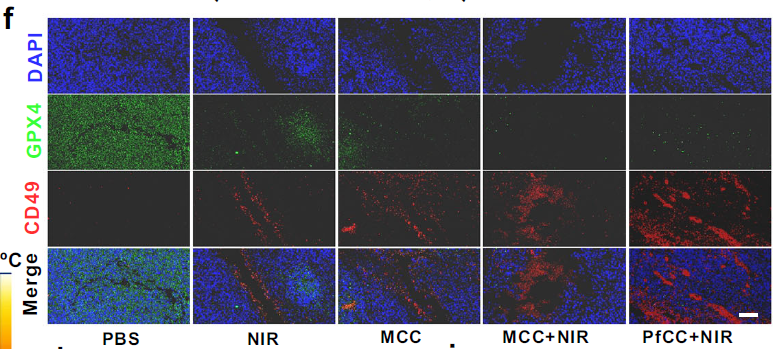 Fig. 5 | Antitumour study for subcutaneous CRC. a TUNEL and HE staining of tumour sites in subcutaneous CT26 tumour bearing mice treated with PBS, NIR, MCC, MCC + NIR, and PfCC+NIR. Images are representative of three biologically independent mice. Scale bar: 200 μm. b–f ELISA of IL-6, TNF-α, and IL-1β, and Immunofluorescence staining of CD86 and CD206, CD49 and GPX4. Data are
presented asmean ± standard deviation (n = 5 independentmouse for (b, c, andd). Statistical differences were calculated using two-tailed Student’s t test, *: p<0.05; **: p < 0.01; ***: p < 0.001. Images are representative of three biologically
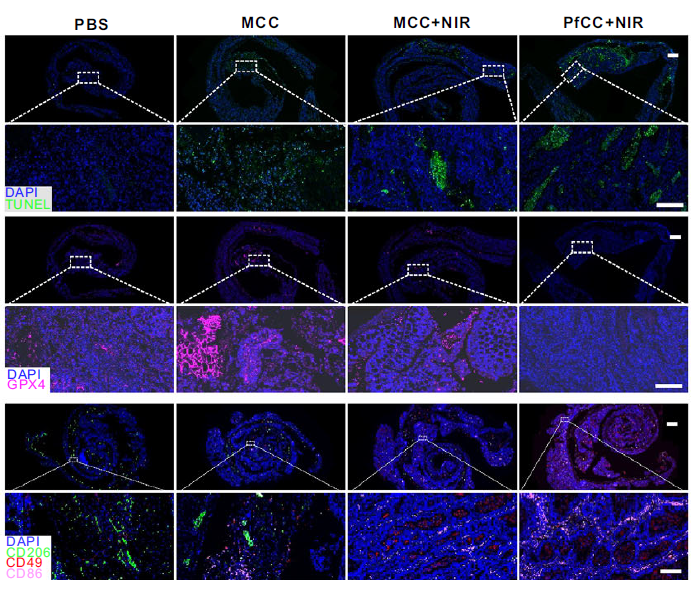
Fig. 7 | In situ anti-tumour study of CRC. r Immunofluorescence staining of colorectal TUNEL, CD49, GPX4, CD86, and CD206 after 2 d of treatment. Images are representative of three biologically independent mice. Scale bar: 1mm, 200 μm, 1mm, 200 μm, 1mm, and 100 μm from top to bottom.
- 2. Cell Subpopulation Quantitative Analysis: Utilizing flow cytometry (Fig. 7n in original text) to precisely quantify CD49b⁺ NK cell proportion changes in tumors, spleen, and lymph nodes, confirming that PfCC promotes NK cell migration to tumor sites and enhances local anti-tumor immunity;
- 3. Therapeutic Mechanism Corroboration: The activation of CD49b⁺ NK cells positively correlated with tumor cell apoptosis rates, providing direct cytological evidence for the "photothermal ablation + immune activation" synergistic mechanism and supporting the therapeutic rationale of PfCC.
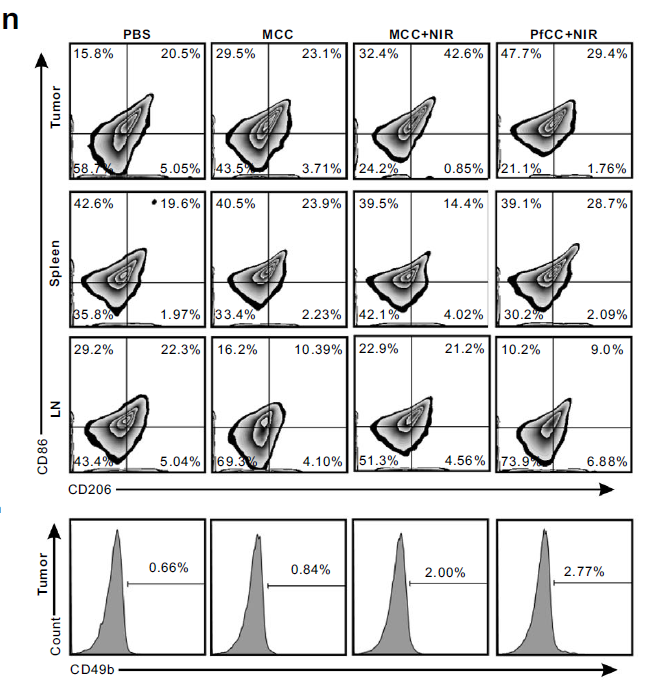
Fig. 7 | In situ anti-tumour study of CRC. n Flow cytometry analysis of M1 (CD 86+) and M2 (CD206+) cell in tumours, spleen, and lymph nodes, and NK cells (CD49b) in tumours.
In Fig. 5f of the original text, CD49b⁺ NK cells (red fluorescence) showed significantly higher distribution density in tumor tissues of the PfCC+NIR group compared to other groups; flow cytometric data in Fig. 7n further quantified that the proportion of CD49b⁺ NK cells in tumor tissues of this group increased nearly 3-fold compared to the PBS group, fully validating the immune activation efficacy of the platform.
IV. Industry Significance and Absin Commitment: Empowering Precision Medicine Innovation with Quality Tools
The publication of this study not only provides a novel therapeutic strategy for colorectal cancer combining targeting, safety, and synergy, but also expands the application boundaries of endogenous gas signaling molecules in cancer therapy. Through "upstream microbiota modulation + downstream gas scavenging" dual intervention, the PfCC platform fundamentally remodels the tumor microenvironment, offering new insights for addressing drug resistance issues.
As a reliable partner in life science research, Absin consistently empowers scientific innovation with high-quality reagents. The CD49b antibody supporting this study, with its advantages of high specificity and low background, precisely captured NK cell activation signals, providing stable data support for immune mechanism dissection. Moving forward, Absin will continue focusing on frontier fields including tumor immunology and nanomedicine, providing one-stop solutions covering antibodies, reagents, and consumables to help more research teams overcome technical bottlenecks and accelerate the translation of scientific achievements to clinical applications.
This content is based on the original publication in Nature Communications (DOI:10.1038/s41467-025-65876-9), interpreted and compiled by AI; all original figures, data, and intellectual property rights belong to the original journal and research team. Should any infringement occur, please contact us promptly for removal, and we will actively cooperate in addressing such matters.
|
Item NO. |
Product Name |
Size |
| abs1850117 | PE Rat anti-Mouse CD49b Antibody(DX5) | 25T/100T |
Contact Absin
Absin provides antibodies, proteins, ELISA kits, cell culture, detection kits, and other research reagents. If you have any product needs, please contact us.
| Absin Bioscience Inc. worldwide@absin.cn |
 Follow us on Facebook: Absin Bio Follow us on Facebook: Absin Bio |