

- Cart 0
- English
[IF 21.1] Decoding the Immune Switches in Hepatitis B: How Absin Reagents Powered a Single-Cell + Spatial Multi-Omics Breakthrough
December 01, 2025
Clicks:79


Title: The core cellular network modulates immune phenotype switching in hepatitis B
Journal: Science Bulletin (IF 21.1)
DOI: https://doi.org/10.1016/j.scib.2025.03.038
Key Reagents: 5-color multiplex fluorescent IHC kit (abs50013), Citrate-EDTA antigen retrieval solution (abs9249)


I. Research Rationale: Multi-dimensional dissection of the core logic governing immune-phenotype switching in HBV infection
HBV infection exhibits extreme clinical heterogeneity; immune status differs markedly among the immune-tolerant (IT), immune-active (IA), inactive-carrier (ICI) and acute-hepatitis-B (AHB) phases, yet the core regulatory circuitry remains incompletely defined. Adopting a “clinical-stratification → multi-omics integration → functional validation” pipeline, the authors established a comprehensive research framework:
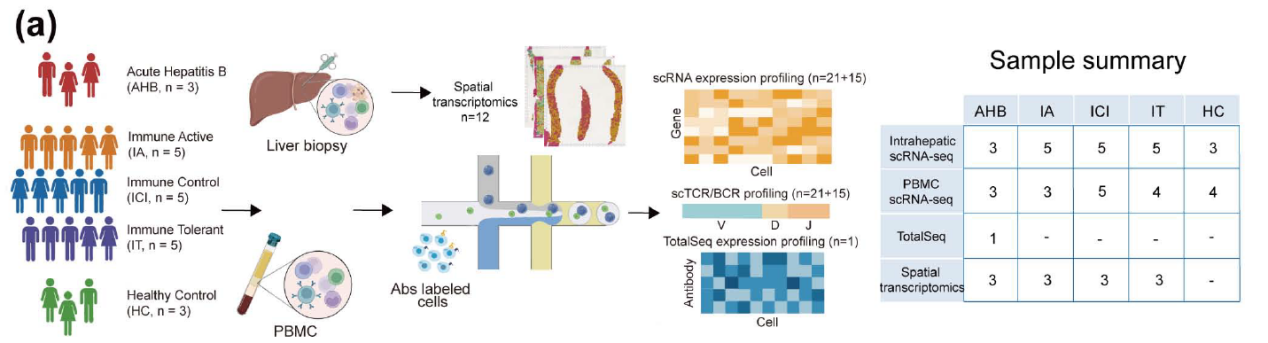
Sample cohort: 18 liver-biopsy and 15 matched peripheral-blood samples covering IT/IA/ICI/AHB stages, plus healthy controls; stringent exclusion criteria ensured sample purity.
Technology matrix: single-cell RNA-seq, spatial transcriptomics, multiplex IHC, TCR/BCR-seq and in-vitro PBMC stimulation, achieving a “cell subset → gene expression → spatial mapping → functional validation” workflow.
Central aim: decipher intra-hepatic and peripheral immune-cell phenotypes, inter-cellular interaction networks and the molecular switches that drive immune-phenotype transitions across HBV phases.
Key-technology flow-chart:
II. Major Findings: three key discoveries in HBV immune regulation
1. Divergence of CD8⁺ T-cell subsets dictates immune-state switching
Two intra-hepatic CD8⁺ T-cell subsets were identified:
- GZMK⁺ CD8⁺ T cells: enriched in AHB and IA, exhibit liver-residency and exhaustion signatures (high CXCR6, PDCD1), mediating cytotoxicity via FasL/Fas or IFN-γ.
- GZMB⁺ CD8⁺ T cells: enriched in IT, exert cytotoxicity through perforin and inversely correlate with clinical inflammatory indices.
Pseudotime trajectory analysis further revealed three HBV-specific CTL (hpCTL) states: FASLG⁺ State-3 dominates IA, whereas GZMB⁺PRF1⁺ State-1 dominates IT, offering stage-specific therapeutic targets (Fig. S3a, S8).
2. A multi-cellular interaction network governs immune tolerance versus activation
- Hepatocytes: peri-portal Hep-2 subset in IT shows higher HBV infection frequency, high MHC-I but low co-stimulatory molecules (CD40, CD80), driving CD8⁺ T-cell dysfunction.
- Macrophages: MRC1⁺CDH5⁺ Kupffer cells up-regulate antigen-presentation (HLA, TAP1) and co-stimulatory molecules, enhancing IL-2 signalling in AHB/IA and rescuing CD8⁺ T-cell function.
- Regulatory circuits: PGE2-EP4 signalling is activated in IA (plasma PGE2 positively correlates with ALT), suppressing CD8⁺ T-cell cytotoxicity; IL-33⁺ liver-sinusoidal-endothelial cells and DC-SIGN⁺ macrophage-mediated type-2 immunity are markedly enhanced in IA (Fig. S5, S6).
3. Clinical relevance: immune subsets correlate with disease progression
Exhausted CD8⁺ T cells, Tregs and CXCL13⁺ Tfh cells positively correlate with plasma ALT and histological inflammation grades, whereas GZMB⁺ CD8⁺ T cells show inverse correlation, offering potential biomarkers for HBV prognosis (Fig. S11).
III. Absin Products Empower Key Experiments: core tools for multiplex IHC
In this study multiplex fluorescent IHC was pivotal for mapping intra-hepatic cell localisation and phenotypes, and was reliably supported by two Absin reagents:
1. Product list
| Product | Cat. No. | Application |
|---|---|---|
| TSA 5-color kit | abs50013 | Multiplex fluorescent IHC staining |
| Citrate-EDTA Antigen Retrieval Solution | abs9249 | Antigen retrieval in FFPE sections |
2. Role in the study
(1) Citrate-EDTA Antigen Retrieval Solution (abs9249) – foundation for success
Step: pre-treatment of liver FFPE sections before multiplex IHC.
Function: reverses formaldehyde-induced cross-linking, efficiently exposes epitopes (protocol: “transferred to pre-heated Citrate-EDTA Antigen Retrieval Solution (abs9249, Absin) before being heat-treated using a microwave for 15 minutes”), ensuring subsequent antibody binding.
Value: underpins robust detection of CD8, GZMK, GZMB and other key markers.
(2) TSA 5-color kit (abs50013) – simultaneous visualisation of multiple markers
Step: multiplex labelling of CD8⁺ T-cell subsets and functional molecules in liver sections.
Function: tyramide-signal-amplification allows five targets (CD8, GZMK, GZMB, Transferrin, DAPI) to be detected simultaneously in separate fluorescent channels, enabling co-localisation of cell subsets and functional phenotypes (protocol: “paired with TSA 5-color kit (abs50013-20T, Absin). Finally, they were stained with DAPI”).
Value: provides direct visual evidence for spatial distribution of GZMK⁺ vs GZMB⁺ CD8⁺ T cells and their neighbourhood interactions with hepatocytes and macrophages (Fig. S2c, S4i).
3. Key panels supported by Absin reagents
| Panel | Content | Absin contribution |
|---|---|---|
| Fig. S2c | Fluorescent staining of CD8⁺ T-cell subsets (GZMB⁺, GZMK⁺) in liver | abs9249 exposes epitopes; abs50013-20T enables simultaneous five-colour detection |
| Fig. S4i | Spatial localisation of AREG, EGFR, etc. | TSA amplification secures detection of low-abundance targets |
| Fig. S1b/d | Clustering and phase-specific proportions of intra-hepatic cells | mIHC validates scRNA-seq annotation |
IV. Absin – Your reliable partner in scientific discovery
This multi-dimensional dissection of HBV immune regulation would not have been possible without precise and robust experimental tools. Absin’s TSA multiplex kits and antigen-retrieval reagents, recognised for consistent performance and high efficiency, empowered the team to achieve accurate multi-marker detection in liver tissue, providing critical technical support for the published conclusions.
From immune-phenotyping and tumour-microenvironment profiling to infectious-disease immunology, Absin remains committed to supplying premium research tools. We continuously optimise our IHC, flow-cytometry and molecular-biology portfolios to help scientists overcome experimental bottlenecks and accelerate translational research.
Moving forward, Absin will keep pace with cutting-edge technologies and launch innovative products tailored to emerging needs, standing side-by-side with the global research community to explore the mysteries of life and advance medicine.
Products used in this paper
| Cat. No. | Name | Size |
|---|---|---|
| abs50013 | 5-color multiplex fluorescent IHC staining kit | 20T/50T/100T |
| abs9249 | Citrate-EDTA antigen retrieval solution | 100 mL |
More multiplex fluorescent IHC kits
| Cat. No. | Product Name | Size |
|---|---|---|
| abs50086 | 2-color multiplex fluorescent IHC kit (anti-rabbit secondary) | 100T |
| abs50087 | 2-color multiplex fluorescent IHC kit (mouse/rabbit universal secondary) | 100T |
| abs50088 | 3-color multiplex fluorescent IHC kit (anti-rabbit secondary) | 100T |
| abs50089 | 3-color multiplex fluorescent IHC kit (mouse/rabbit universal secondary) | 100T |
| abs50012 | 4-color multiplex fluorescent IHC kit (mouse/rabbit universal secondary) | 20T/50T/100T |
| abs50168 | 4-color multiplex fluorescent IHC kit B (anti-rabbit secondary) | 20T/50T/100T |
| abs50013 | 5-color multiplex fluorescent IHC kit (mouse/rabbit universal secondary) | 20T/50T/100T |
| abs50029 | 5-color multiplex fluorescent IHC kit (anti-rabbit secondary) | 20T/50T/100T |
| abs50014 | 6-color multiplex fluorescent IHC kit (mouse/rabbit universal secondary) | 20T/50T/100T |
| abs50030 | 6-color multiplex fluorescent IHC kit (anti-rabbit secondary) | 20T/50T/100T |
| abs50015 | 7-color multiplex fluorescent IHC kit (mouse/rabbit universal secondary) | 20T/50T/100T |
| abs50031 | 7-color multiplex fluorescent IHC kit (anti-rabbit secondary) | 20T/50T/100T |
| abs50018 | 10-color multiplex fluorescent IHC kit | 100T |
| abs50083 | Lung-cancer tumour-microenvironment multiplex IHC kit (I) | 20T |
| abs50084 | Lung-cancer tumour-microenvironment multiplex IHC kit (II) | 20T |
[Disclaimer] This article is based on the publication in Science Bulletin (DOI: 10.1016/j.scib.2025.03.038) and has been compiled by AI. All original figures and data are the intellectual property of the journal and the authors. If any infringement is identified, please contact us for prompt removal.
Contact Absin
Absin provides antibodies, proteins, ELISA kits, cell culture, detection kits, and other research reagents. If you have any product needs, please contact us.
| Absin Bioscience Inc. worldwide@absin.cn |
 Follow us on Facebook: Absin Bio Follow us on Facebook: Absin Bio |