

- Cart 0
- English
Crack the AD Code! Filipin III & CTxb-FITC: The Gold-Standard Probe Duo for Cholesterol Metabolism and Lipid-Raft Mechanisms
November 21, 2025
Clicks:122


As Alzheimer’s disease (AD) research zeroes in on APOE4-driven neuroimmune dysregulation, cholesterol accumulation and lipid-raft anomalies have emerged as pivotal pathogenic hubs. Are you seeking reagents that can precisely capture these molecular alterations?
A recent Translational Neurodegeneration (IF = 10.8) study entitled “TRPV1 alleviates APOE4-dependent microglial antigen presentation and T cell infiltration in Alzheimer’s disease” provides new mechanistic insight: APOE4 triggers ER-stress–Ca²⁺–SREBP2-mediated cholesterol overload in microglia, enhancing MHC-II antigen presentation and T-cell infiltration, whereas a TRPV1 agonist reverses this cascade. Notably, the quantitative backbone of this work was built with Absin Filipin III and Absin CTxb-FITC —a “probe duo” now proving indispensable for AD and neurodegeneration research.
Filipin III: A “Visual Detective” for Cholesterol Dyshomeostasis
In AD pathology, microglial cholesterol accumulation is the fuse that ignites immune dysregulation. Filipin III, a fluorescent polyene antibiotic, makes this “invisible” alteration visible:
Precise localization: Binds selectively to unesterified cholesterol; blue fluorescence (Ex/Em ≈ 355/460 nm) maps cholesterol distribution in BV2 cells or brain sections, whether diffuse cytosolic pools or lysosomal aggregates.
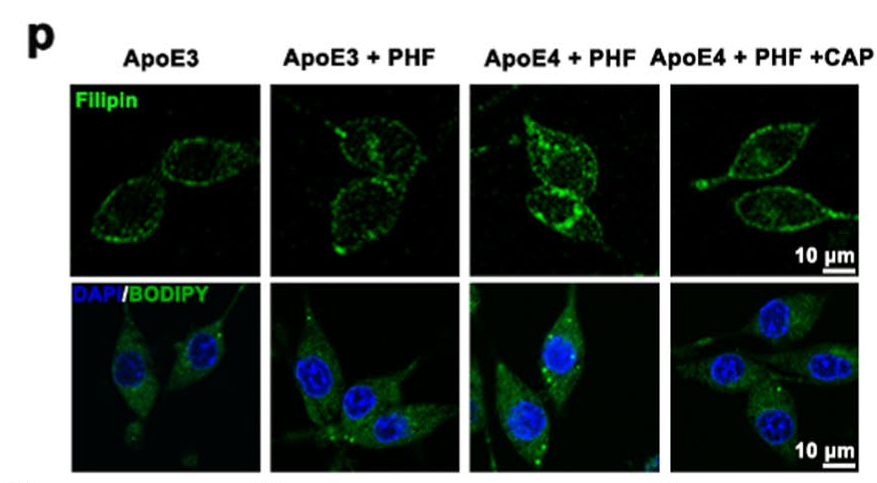
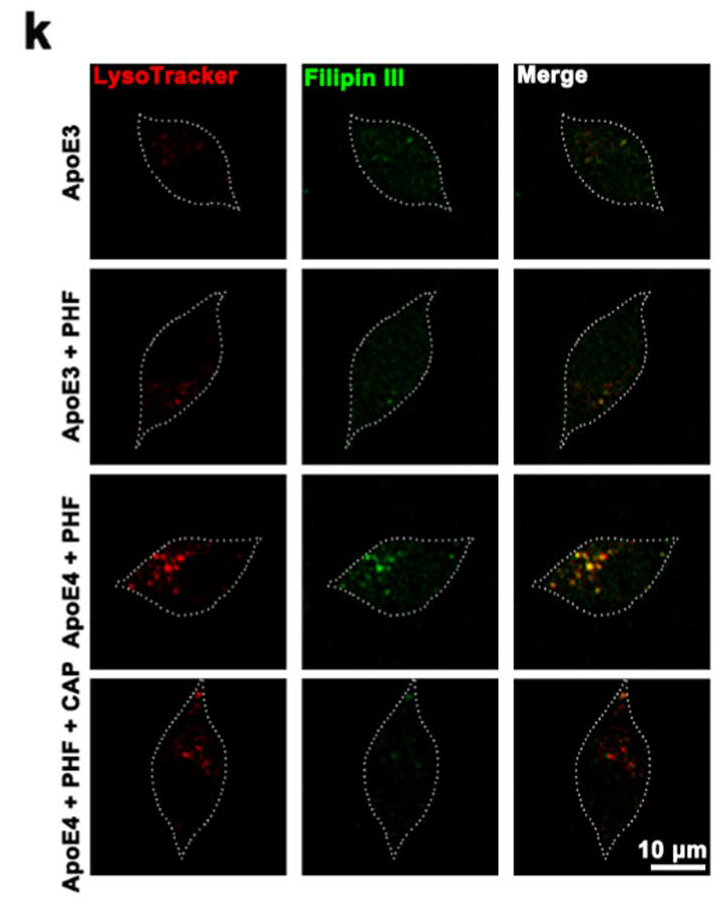
Quantitative read-out: 50 µg/mL, 2 h staining followed by ImageJ quantification revealed significantly higher cholesterol in APOE4+PHF vs APOE3 microglia, an effect reversed by capsaicin, providing direct evidence that cholesterol overload is an APOE4-driven pathogenic node.
Broad compatibility: Combines with LysoTracker Red for sub-cellular co-localization; validated in both cultured cells and mouse hippocampal slices, bridging in-vitro and in-vivo data.
|
|
|
CTxb-FITC: A “Positioning Navigator” for Lipid Rafts and Antigen Presentation
Lipid rafts serve as plasma-membrane signaling platforms. Their association with MHC-II molecules is crucial for antigen presentation. CTxb-FITC (cholera toxin B subunit conjugated to FITC) unlocks this mechanism:
Raft-specific labeling: Binds GM1 ganglioside in rafts; green fluorescence (Ex/Em ≈ 495/519 nm) outlines raft topography, providing a spatial reference for MHC-II mapping.
Co-localization analytics: 8 µg/mL CTxb-FITC + 2 µg/mL MHC-II-PE, 4 °C, 30 min. Confocal imaging revealed increased MHC-II raft localization in APOE4+PHF microglia, an effect counteracted by capsaicin, directly demonstrating that APOE4 enhances antigen presentation via lipid rafts.
Streamlined workflow: No pre-treatment required; compatible with standard IF pipelines, delivering stable signals and high-quality co-localization data.
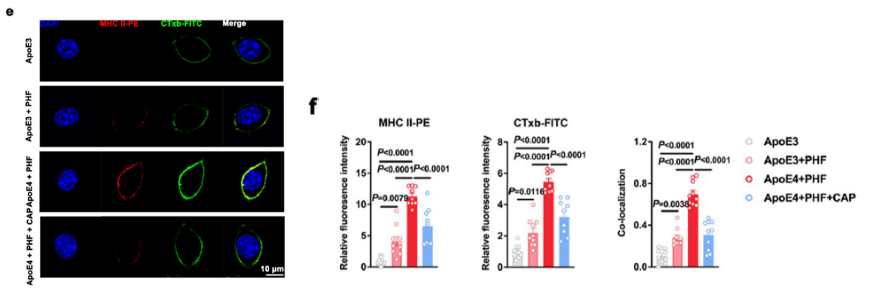 MHC-II raft distribution (CTxb-FITC) after APOE4+PHF and capsaicin intervention in BV2 microglia
Filipin III vs CTxb-FITC: Experimental Workflow at a Glance
| Parameter | Filipin III (cholesterol probe) | CTxb-FITC (lipid-raft probe) |
|---|---|---|
| Core function | Visualizes & quantifies unesterified cholesterol; co-stains with LysoTracker for sub-cellular localization | Labels GM1 ganglioside in lipid rafts; maps MHC-II raft recruitment during antigen presentation |
| Sample types | BV2 microglia (in vitro); mouse hippocampal slices (ex vivo) | BV2 microglia (in vitro) |
| Key steps | Fix 4 % PFA 20 min → PBS wash → 50 µg/mL Filipin III 2 h RT → optional 50 nM LysoTracker Red 30 min 37 °C → DAPI 10 min | Fix 4 % PFA 10 min → 5 % BSA block → 8 µg/mL CTxb-FITC + 2 µg/mL MHC-II-PE 30 min 4 °C → DAPI 10 min |
| Imaging/analysis | Confocal 40×/63×; ImageJ fluorescence intensity or positive-area quantification | Confocal 63× 1.4 NA; ImageJ co-localization coefficient (MHC-II vs CTxb-FITC) |
| Study conclusion | APOE4 elevates microglial cholesterol; capsaicin reverses this overload | APOE4 enhances MHC-II raft clustering; capsaicin dampens raft-based antigen presentation |
In the era of mechanistic precision, reliable reagents are the key to unlocking AD pathobiology. Validated in high-impact publications, Absin Filipin III (cat# abs42018484) and CTxb-FITC (cat# abs80003) deliver visualization plus quantification for cholesterol homeostasis and lipid-raft biology—empowering your next breakthrough.
References
[1] Transl Neurodegener. 2024 Oct 29;13(1):52. doi: 10.1186/s40035-024-00445-6. PMID: 39468688 IF:10.8[2] Gastroenterology. 2025 Sep;169(4):615-631.e32. doi: 10.1053/j.gastro.2025.03.019. Epub 2025 Mar 28. PMID: 40158738 IF:25.7
[3] Autophagy. 2025 Jun;21(6):1263-1282. doi: 10.1080/15548627.2025.2469129. Epub 2025 Mar 10. PMID: 39988734 IF:14.6
[4] Redox Biol. 2025 Feb:79:103469. doi: 10.1016/j.redox.2024.103469. Epub 2024 Dec 12. PMID: 39700693 IF:10.7
[5] Antiviral Res. 2023 Aug:216:105662. doi: 10.1016/j.antiviral.2023.105662. Epub 2023 Jun 29. PMID: 37393054 IF:7.6
[6] J Transl Med. 2023 Oct 17;21(1):733. doi: 10.1186/s12967-023-04609-2. PMID: 37848983 IF:7.4
Contact Absin
Absin provides antibodies, proteins, ELISA kits, cell culture, detection kits, and other research reagents. If you have any product needs, please contact us.
| Absin Bioscience Inc. worldwide@absin.cn |
 Follow us on Facebook: Absin Bio Follow us on Facebook: Absin Bio |