

- Cart 0
- English
[IF 30.9] Cracking the CRC Code: Absin C26-Ceramide Decodes the Microbiota–Metabolism–Tumor Axis
November 03, 2025
Clicks:450


Colorectal cancer (CRC) ranks among the leading causes of cancer-related mortality worldwide; ~50 % of patients develop metastatic disease, yet current therapeutic regimens remain suboptimal in a substantial subset. A breakthrough Cell Metabolism study (IF 30.9) now deciphers a previously unrecognized “gut microbiota–ceramide metabolism–CRC progression” axis and proposes actionable intervention strategies. Absin C26-ceramide (Cat# abs44108154), employed as the key experimental reagent, provided a chemically defined and batch-consistent metabolic probe that enabled rigorous validation of the central hypothesis.
Title: Microbial riboflavin inhibits ceramide synthase 3 to lower ceramide (d18:1/26:0) and delay colorectal cancer progression
Journal: Cell Metabolism (IF 30.9)
DOI: https://doi.org/10.1016/j.cmet.2025.06.002
Key Reagent: C26-ceramide (abs44108154)


I. Translational Framework: From Clinical Metabolic Dysregulation to Mechanism-Guided Intervention
Starting from the clinical observation that lipidomic rewiring parallels CRC aggressiveness, the authors designed a four-step discovery pipeline—(i) biomarker identification, (ii) mechanistic dissection, (iii) microbial–host crosstalk, and (iv) therapeutic repurposing—to delineate the C26-ceramide-driven oncogenic circuit.
II. Key Discoveries: Unraveling the Pro-tumorigenic C26-CERS3-EGFR Axis
1. Clinical Insight: C26-ceramide is a metabolic driver of CRC progression
Lipidomic profiling of 101 CRC patients (PUTH cohort) revealed that very-long-chain C26-ceramide (d18:1/26:0) is markedly elevated in tumor tissue, plasma and feces, and positively correlates with advanced AJCC stage, T-stage, lymphovascular and perineural invasion, establishing C26 as both a prognostic biomarker and a candidate oncometabolite.
2. Mechanistic Core: C26 activates EGFR signaling to fuel proliferation
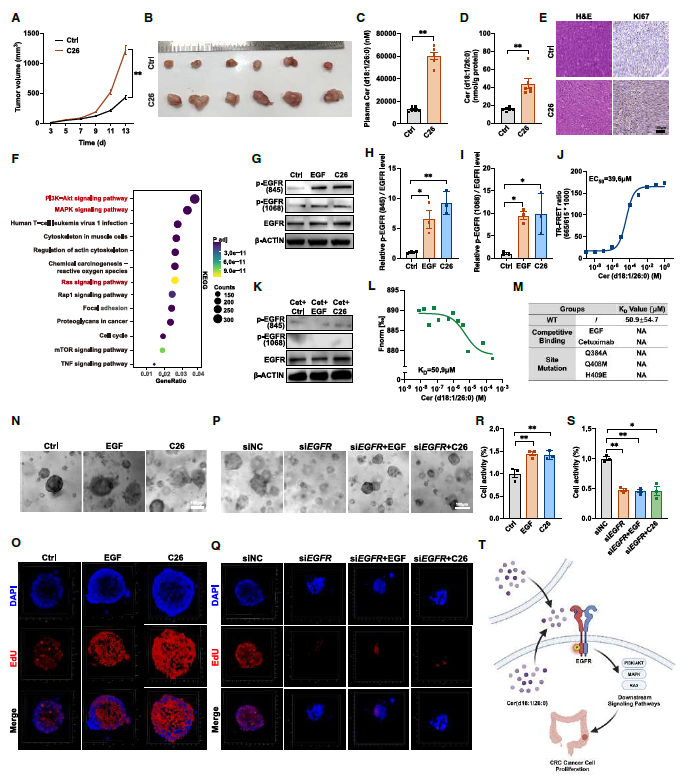
C26 binds EGFR and accelerates CRC growth in vitro and in vivo
- In vitro: Absin C26-ceramide (10–50 µM) dose-dependently enhanced MC38 cell proliferation, colony formation and migration without compromising immune cell viability.
- In vivo: Intraperitoneal C26 (10 mg/kg) significantly increased tumor burden and Ki67 index in MC38 xenografts.
- Signaling: Surface plasmon resonance and co-immunoprecipitation demonstrated direct C26–EGFR interaction, leading to downstream activation of PI3K/AKT, MAPK and RAS cascades; EGFR knock-out abolished C26-mediated oncogenic effects.
3. Enzymatic Control: CERS3 dictates C26 biogenesis
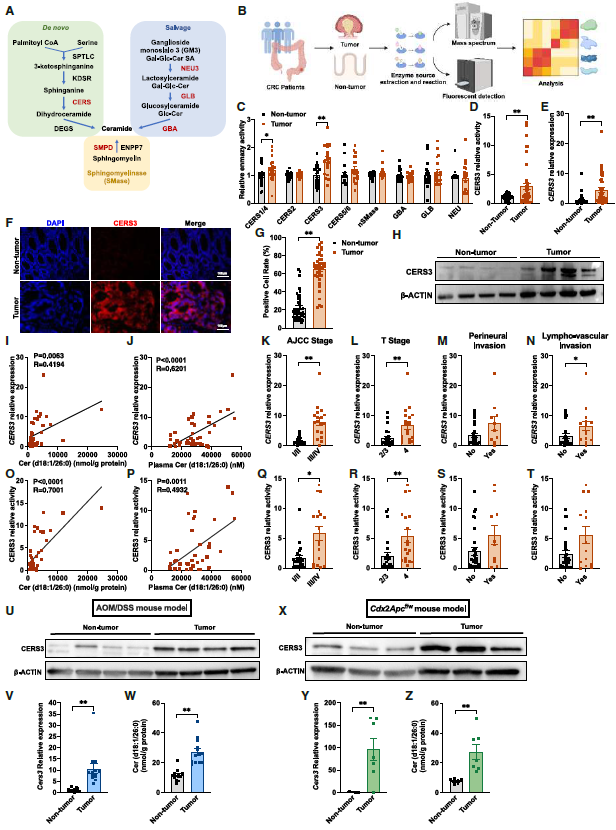
CERS3 expression governs C26 synthesis in CRC
Among six mammalian ceramide synthases, only CERS3 exhibited elevated expression and activity in human and murine CRC tissues; its mRNA levels tightly correlated with intratumoral C26 content and aggressive clinicopathological features, establishing CERS3 as the rate-limiting enzyme for oncogenic C26 accumulation.
4. Microbial Gatekeeper: Bacteroides cellulosilyticus restrains CERS3 via riboflavin
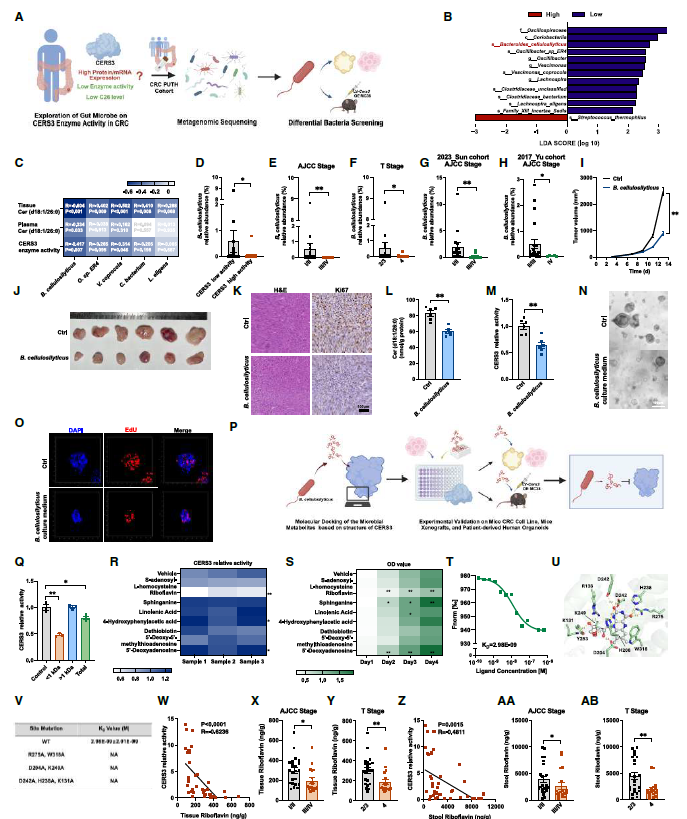
B. cellulosilyticus-derived riboflavin antagonizes CERS3 activity
Metagenomic sequencing uncovered an inverse correlation between B. cellulosilyticus abundance and C26 levels. The commensal secretes riboflavin that directly binds and allosterically inhibits CERS3, thereby lowering C26 and attenuating tumor growth; loss of this microbial control in advanced CRC explains paradoxical C26 accumulation despite host CERS3 up-regulation.
5. Therapeutic Translation: Aclidinium bromide (AB) repurposed as a CERS3-directed inhibitor
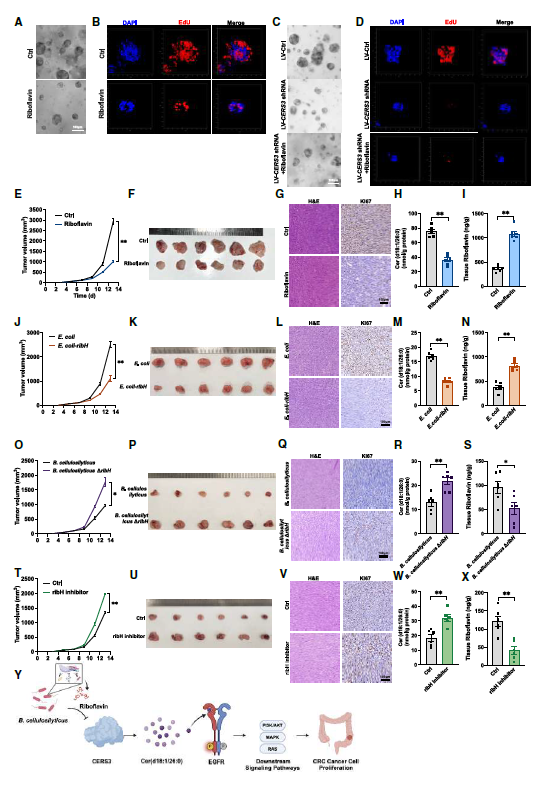
Aclidinium bromide binds CERS3 and curbs CRC progression
In-silico screening of an FDA-approved drug library identified the COPD medication aclidinium bromide as a selective CERS3 ligand. AB decreased C26 content and suppressed tumor growth in CERS3-overexpressing MC38 xenografts, offering an immediately testable “drug-repositioning” opportunity for CRC patients.
III. Powered by Absin: C26-Ceramide (abs44108154) as the Experimental Cornerstone
Absin C26-ceramide (>98 % purity by LC-MS) served as the definitive metabolic probe throughout the study, ensuring reproducible dose–response relationships across cellular, organoid and murine models.
| Model System | Experimental Goal | Absin C26-Ceramide Utility |
|---|---|---|
| MC38 cells | Quantify pro-proliferative/migratory potency | Dose-gradient (10–50 µM) revealed EC50 and maximal effect |
| Mouse xenograft | Validate tumor-promoting activity in vivo | 10 mg kg−1 i.p. elevated plasma/tumor C26 and accelerated growth |
| Patient-derived organoids | Confirm human relevance & EGFR activation | Increased p-EGFR and EdU+ fraction, phenocopying EGF |
| Signaling assays | Map downstream pathways | Parallel to EGF, triggered PI3K/AKT & MAPK cascades |
IV. Conclusions & Future Directions
This study establishes the “B. cellulosilyticus–riboflavin–CERS3–C26–EGFR” axis as a druggable metabolic circuitry in CRC. C26-ceramide emerges as a predictive biomarker, while CERS3-directed interventions (riboflavin supplementation or aclidinium bromide) offer rapid translational opportunities.
Absin provides a full spectrum of metabolites, antibodies and assay kits to accelerate oncology, microbiome and drug-repurposing research. Explore our complete ceramide portfolio, EGFR signaling antibodies, and EdU/CCK-8 detection systems at www.absin.net.
Product Cited
| Cat# | Product Name | Size |
|---|---|---|
| abs44108154 | C26-Ceramide | 5 mg / 50 mg |
Contact Absin
Absin provides antibodies, proteins, ELISA kits, cell culture, detection kits, and other research reagents. If you have any product needs, please contact us.
| Absin Bioscience Inc. worldwide@absin.cn |
 Follow us on Facebook: Absin Bio Follow us on Facebook: Absin Bio |