

- Cart 0
- English
Biochemical Detection Kit: Hydroxyproline Detection and Assessment of Pulmonary Fibrosis Severity
December 23, 2024
Clicks:1828


Background:
Hydroxyproline (HYP) is an essential component of protein and polypeptide precursors, a free amino acid that lacks metabolic pathways in the body and is primarily excreted unchanged through urine. Its physiological function is similar to that of lysine, as both are important constituents of amino acids. Hydroxyproline has multiple biological functions within the body and is closely related to many significant physiological activities and pathological changes. In mammals, it is found exclusively in collagen and elastin, whereas in plants, many proteins contain hydroxyproline. The human body contains a substantial amount of hydroxyproline, which serves not only as a raw material for protein synthesis but also as a precursor for the synthesis of antibodies and cytokines. Various diseases, such as tumors and inflammation, can affect the renewal of collagen, potentially leading to increased levels of hydroxyproline in the serum or urine.
Application of Hydroxyproline Detection in the Assessment of Pulmonary Fibrosis:
Studies have indicated that excessive deposition of collagen is a primary characteristic of fibrotic diseases. Hydroxyproline (HYP), an amino acid unique to collagen, accounts for approximately 13% of the total amino acids in collagen. Therefore, determining the total content of hydroxyproline in tissues using biochemical methods such as colorimetry and high-performance liquid chromatography (HPLC) has gradually become the most commonly used methodology for assessing the severity of fibrosis. In 2017, this methodology was established as the "gold standard" for pre-clinical evaluation of pulmonary fibrosis by the American Thoracic Society guidelines.
In March 2023, Associate Professor Chen Yongyan's team from the School of Basic Medical Sciences at the University of Science and Technology of China published a research paper titled "UGRP1-modulated MARCO+ alveolar macrophages contribute to age-related lung fibrosis" in the journal Immunity & Ageing. This study primarily investigated how the aging lung is more susceptible to chronic pulmonary diseases. The research found that aged respiratory epithelial cells significantly upregulate the expression of Uteroglobin-Related Protein 1 (UGRP1), leading to increased levels of CCL6 in the aging lung. Additionally, alveolar macrophages (AM) undergo essential changes with aging, characterized by a reduction in cell number and alterations in gene expression. The upregulation of UGRP1 and MARCO+ AM is involved in the progression of pulmonary fibrosis. Therefore, UGRP1 modulates MARCO+ AM in age-related pulmonary fibrosis in a CCL6-dependent manner, which is key to establishing optimal targeting for the aging population.
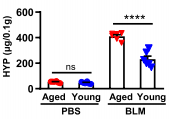
Figure: Detection of lung tissue using a hydroxyproline content test kit (product number abs580066).
Hydroxyproline Content Detection Kit:
|
Components |
Size |
Storage |
|
96-Well Microplate |
1 plate |
Room temperature |
|
Substrate |
Powder x 1 |
Store at 4°C, protected from light. |
|
Substrate Diluent |
8 mL x 1 |
Store at 4°C, protected from light. |
|
Stop Solution |
4 mL x 1 |
Store at 4°C |
|
Dye Reagent |
Powder x 1 |
Store at 4°C, protected from light. |
|
Dye Reagent Diluent |
4 mL x 1 |
Store at 4°C |
|
Standard |
Powder x 1 |
Store at 4°C |
|
Plate Adhesive Strips |
3 Strips |
Room temperature |
Additional materials required: Microplate reader (capable of reading absorbance at 560 nm), Distilled water, Pipette and tips, Mortar and pestle, Centrifuge, Autoclave, 6 mol/L Hydrochloric acid (HCl), 10 mol/L Sodium hydroxide (NaOH), Ethanol, etc.
Procedure (using tissue samples as an example):
1. Sample Preparation: Weigh 1g of tissue and place it in a glass tube, add 1mL of 6mol/L HCl, place in an oven at 110°C for 6 to 12 hours, then centrifuge at 16,000g at 25°C for 20 minutes. Transfer the supernatant to a new centrifuge tube, and then add 10mol/L NaOH to adjust the pH to 7.0.
2. Reagent Preparation:
a) Substrate: Add 8mL of Substrate Diluent to dissolve. (Prepare fresh before use)
b) Dye Reagent: Add 4mL of Dye Reagent Diluent to dissolve. (Prepare fresh before use)
c) Standard: Dissolve the Standard with 1mL of distilled water to obtain Standard ①; take 10μL of Standard ① and add to 990μL of distilled water to obtain Standard ②; take 200μL of Standard ② and add to 800μL of distilled water to prepare a Standard with a concentration of 200μmol/L.
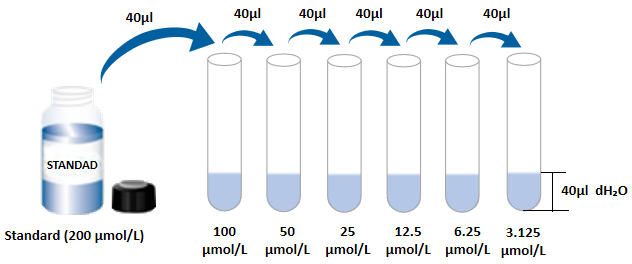
Example of Successive Dilution of the Standard Stock Solution (Doubling Dilution)
3. Sample Application
a) Add 40μL of different concentrations of the standard and samples into the corresponding wells. Also, set up a blank well by adding 40μL of distilled water.
b) Add 80μL of Substrate to each well, mix well, and incubate at room temperature for 20 minutes.
c) Add 40μL of Stop Solution to each well, mix well, and incubate at room temperature for 10 minutes.
d) Add 40μL of Dye Reagent to each well, mix well, and place in an oven at 65°C for a reaction time of 20 minutes, then cool to room temperature.
|
Reagent |
Standard Well |
Sample Well |
Blank Well |
|
Standard |
40uL |
-- |
-- |
|
Sample |
-- |
40uL |
-- |
|
Distilled Water |
-- |
-- |
40uL |
|
Substrate |
80uL |
80uL |
80uL |
|
Mix well and incubate at room temperature for 20 minutes. |
|||
|
Stop Solution |
40uL |
40uL |
40uL |
|
Mix well and incubate at room temperature for 10 minutes. |
|||
|
Dye Reagent |
40uL |
40uL |
40uL |
|
Mix well, place in an oven at 65°C and react for 20 minutes, then cool down to room temperature. |
|||
4. Detection and Calculation: Use a microplate reader to measure the absorbance at 560 nm, fit the standard curve, and calculate the sample concentration.
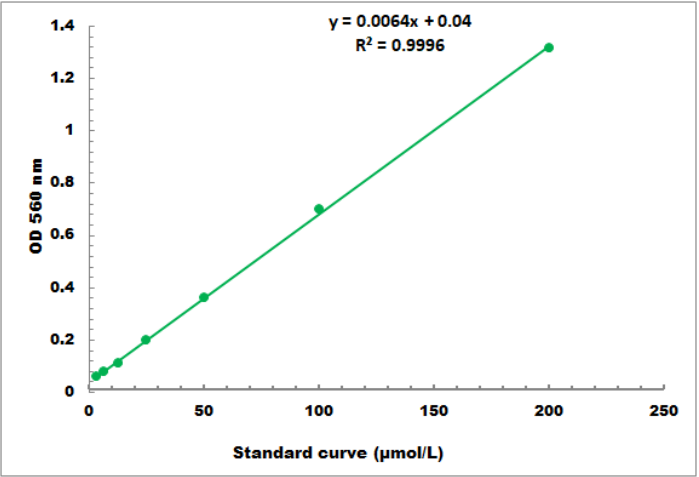
Precautions:
1. For unknown samples, it is recommended to perform a preliminary experiment with several dilution gradients to ensure that the readings are within the range of the standard curve.
2. The reagents in the kit should be prepared and used immediately; prepared solutions cannot be stored as they may affect the color development and thus the detection results. If samples need to be tested in batches, it is advisable to collect and store them in batches, and then conduct the testing all at once when all samples are collected.3. A new standard curve must be detected and plotted for each experiment.
References
Chen Y, Hao X, Li M, Tian Z, Cheng M. UGRP1-modulated MARCO+ alveolar macrophages contribute to age-related lung fibrosis. Immun Ageing. 2023 Mar 18;20(1):14. doi: 10.1186/s12979-023-00338-8. PMID: 36934284; PMCID: PMC10024420.
Absin生化检测试剂盒——氨基酸代谢系列:
|
Item NO, |
Product Name |
|
Alanine Transaminase Microplate Assay Kit |
|
|
Aspartate Transaminase Microplate Assay Kit |
|
|
Glutamate Microplate Assay Kit |
|
|
Glutamate Synthase Microplate Assay Kit |
|
|
Glutaminase Microplate Assay Kit |
|
|
Hydroxyproline Microplate Assay Kit |
|
|
Arginase Microplate Assay Kit |
|
|
Lysine Microplate Assay Kit |
|
|
Proline Microplate Assay Kit |
|
|
Cysteine Microplate Assay Kit |
|
|
Total Amino Acid Microplate Assay Kit |
|
|
Acetolactate Synthase Microplate Assay Kit |
Absin provides antibodies, proteins, ELISA kits, cell culture, detection kits, and other research reagents. If you have any product needs, please contact us.
|
Absin Bioscience Inc. |
 Follow us on Facebook: Absin Bio Follow us on Facebook: Absin Bio |