

- Cart 0
- English
mIHC Literature Interpretation: A New Nano-drug Capable of Inhibiting Postoperative Cancer Recurrence and Metastasis
November 25, 2024
Clicks:251


For most types of cancer, surgical resection is the most important and effective treatment method. However, why do some patients still need chemotherapy after surgery, and why is the recurrence rate of cancer so high? In fact, surgery can only remove the visible cancerous tumors, and then appropriately remove some surrounding "normal" tissue. However, this part of the tissue may appear normal but may already harbor cancer cells. To put it simply: surgical procedures cannot completely eliminate cancer cells. Therefore, if the postoperative pathological results are not optimistic, patients still need to undergo chemotherapy and also need to use some immunotherapeutic drugs to restore the immune cells' ability to kill tumor cells.
Due to the rapid growth of tumor tissue, the high volume expansion, and the incomplete vascular system within the tumor tissue, there is a lack of oxygen supply within the tumor tissue. As a result, the tumor microenvironment often exhibits overall hypoxia. Tumor cells can survive stubbornly in hypoxic environments, but immune cells cannot, and thus such hypoxia also promotes the immune escape of tumors.
On May 20, 2022, researchers Dr. Yue Wenwen from Tongji University School of Medicine, Professor Xu Huixiong from Zhongshan Hospital affiliated with Fudan University, and Professor Chen Yu from Shanghai University, led a team to publish an article titled "Nanoparticle-enhanced radiotherapy synergizes with PD-L1 blockade to limit post-surgical cancer recurrence and metastasis" in the journal Nature Communications. The study constructed a postoperative CT26 mouse colon model to prove that surgical resection creates an immunosuppressive environment characterized by hypoxia and a large influx of myeloid cells, which promotes cancer development and hinders PD-L1 blocking therapy. To address this issue, the team designed and developed a nano-drug, IPI549@HMP, which can target myeloid cells and catalyze the generation of O2 from endogenous hydrogen peroxide, enhancing the effectiveness of radiotherapy and sensitivity to PD-L1 treatment. This approach can inhibit or eliminate residual cancer cells and awaken the patient's own immune system to resist tumor recurrence.
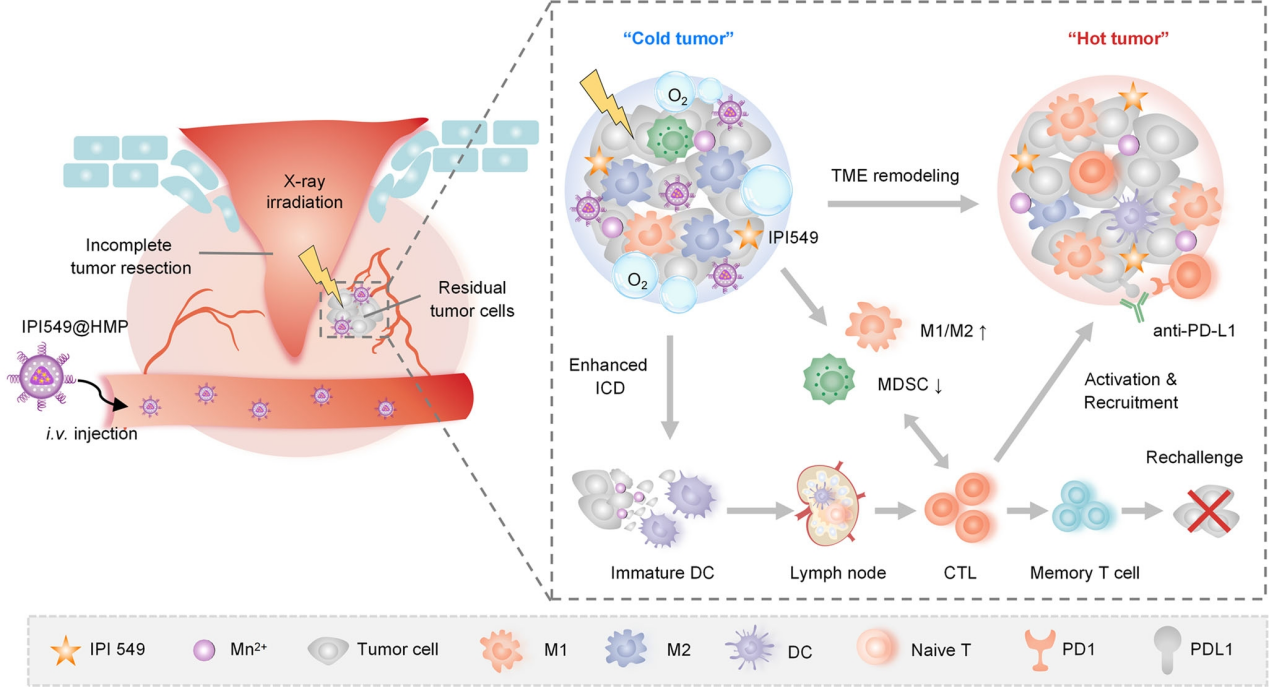
Figure 1: Schematic of IPI549 nanoparticles boosting postoperative immunotherapy by combining radiotherapy and PD-L1 inhibition.
To better observe the changes in the immune microenvironment before and after tumor resection surgery and the therapeutic effect of the nano-drug IPI549@HMP in enhancing tumor immunity, the research team used the Absin five-color multiplex fluorescence immunohistochemistry staining kit (mouse-rabbit universal secondary antibody) — abs50013 for multi-staining. The results showed that compared to untreated tumors, the infiltration of CD45+ immune cells in tumors treated with surgical resection significantly increased, mostly consisting of CD11b+ myeloid cells. Additionally, the proliferation index (Ki-67) and hypoxia index (HIF-α) of postoperative tumors were much higher than before surgery (Figure 2). After combining IPI549@HMP with radiotherapy, the Treg cells (FOXP3+) that suppress the anti-tumor immune response of tumor-bearing hosts and the M2-type macrophages (CD206+) that promote immune evasion significantly decreased compared to before treatment, while the number of CD8+ T cells, which have a cytotoxic effect on tumor cells, noticeably increased (Figure 3). This confirmed that IPI549@HMP could enhance the therapeutic effect of postoperative radiotherapy on tumor-bearing mice.
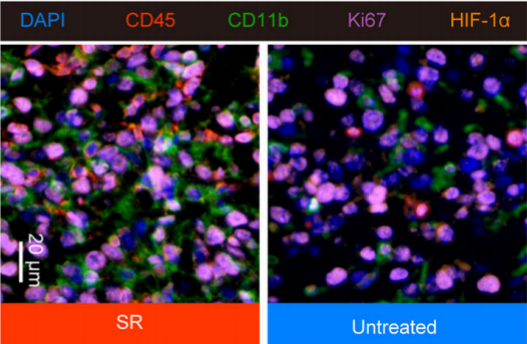
Figure 2
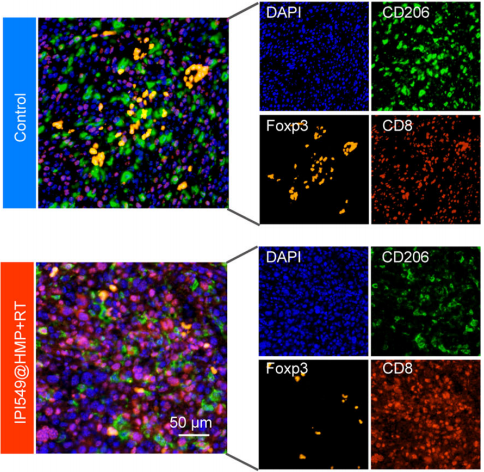
Figure 3
To conquer cancer, one of the leading causes of death in human society today, countless scientists have dedicated their efforts and ingenuity. The emergence of various anti-cancer drugs and treatment methods has also brought hope to many patients. Multi-color fluorescence immunohistochemistry technology, as one of the mainstream methods for exploring the tumor microenvironment, is favored by scholars worldwide because it can present more and richer information on a single slide. We look forward to Absin continuing to contribute its modest strength in the journey of exploring the field of oncology.
References
Guan X, Sun L, Shen Y, Jin F, Bo X, Zhu C, Han X, Li X, Chen Y, Xu H, Yue W. Nanoparticle-enhanced radiotherapy synergizes with PD-L1 blockade to limit post-surgical cancer recurrence and metastasis. Nat Commun. 2022 May 20;13(1):2834. doi: 10.1038/s41467-022-30543-w. PMID: 35595770; PMCID: PMC9123179.
|
Item NO. |
Product Name |
Size |
|
Absin 4-Color IHC Kit (Anti-Rabbit and Mouse Secondary Antibody) |
20T/100T |
|
|
Absin 4-Color IHC Kit(Anti-Rabbit Secondary Antibody) |
20T/100T |
|
|
Absin 5-Color IHC Kit (Anti-Rabbit and Mouse Secondary Antibody) |
20T/100T |
|
|
Absin 5-Color IHC Kit (Anti-Rabbit Secondary Antibody) |
20T/100T |
|
|
Absin 6-Color IHC Kit (Anti-Rabbit and Mouse Secondary Antibody) |
20T/100T |
|
|
Absin 6-Color IHC Kit (Anti-Rabbit Secondary Antibody) |
20T/100T |
|
|
Absin 7-Color IHC Kit (Anti-Rabbit and Mouse Secondary Antibody) |
20T/100T |
|
|
Absin 7-Color IHC Kit(Anti-Rabbit Secondary Antibody) |
20T/100T |
|
|
Antibody eluent (for mIHC) |
30ml |
Absin provides antibodies, proteins, ELISA kits, cell culture, detection kits, and other research reagents. If you have any product needs, please contact us.
|
Absin Bioscience Inc. |
 Follow us on Facebook: Absin Bio Follow us on Facebook: Absin Bio |