

- Cart 0
- English
Cow Mammary Gland Organoid Culture Kit
September 29, 2024
Clicks:485


The branching morphogenesis of the mammary gland in cows is a fundamental condition for the completion of lactation functions. The branching structure of the mammary gland can enhance the milk yield of cows by increasing the number and secretory function of mammary alveolar tissues. 3D culture can induce the branching morphogenesis of tissues and organs in vitro, which is already a widely used method for studying mammary branching morphology.
Organoids are 3D cellular aggregates of organ-specific cell types that develop from stem cells or organ progenitor cells and can self-organize through cell sorting out and spatially restricted lineage differentiation, similar to the way they do in vivo.
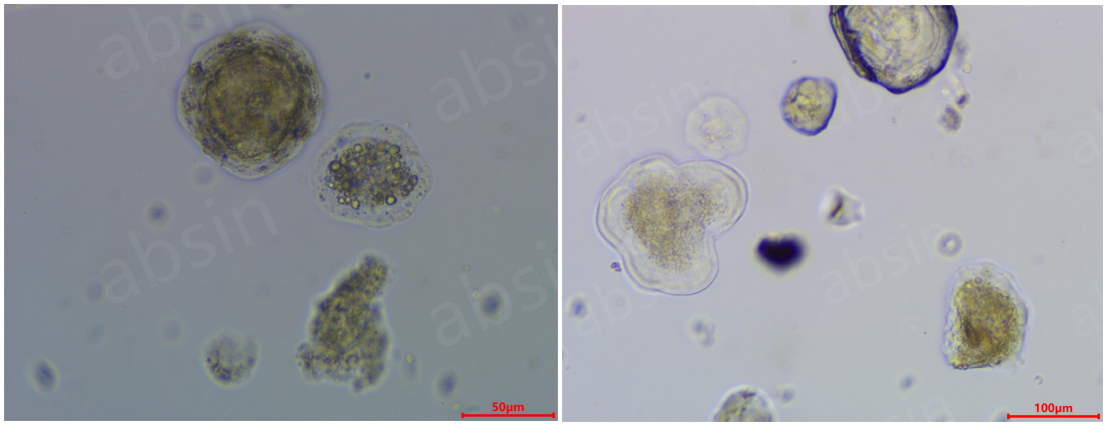
Figure 1: Bright field image display of bovine mammary gland organoids
1. Product Information
|
Item NO. |
Product Name |
Size |
|
Cow Mammary Gland Organoid Culture Kit |
1kit |
2. Component Information
|
NO. |
Component |
Size |
Storage |
|
A |
Cow Mammary Gland Organoid Culture Medium |
100ml |
4°C |
|
B |
Cow Mammary Gland Organoid Culture Buffer |
500ml |
4°C |
|
C |
Cow Mammary Primary Tissue Digestion Fluid |
30ml |
4°C |
|
D |
Organoid Passaging Digestion Liquid |
30ml |
4°C |
|
E |
Tissue Preservation Solution |
100ml |
4°C |
|
F |
Organoid Cryopreservation Solution |
20ml |
4°C |
3. Cultivation Methods
1) The collected bovine mammary tissue must be quickly transported to a clean laboratory in a sampling bottle containing tissue preservation solution E at 2-8°C for tissue processing and stem cell isolation. Photograph and record the information.
2) Prepare several culture dishes and add pre-cooled bovine mammary gland organoid culture buffer B at 4°C.
3) Disinfect the sampling bottle, place the tissue into the culture dish, and wash with bovine mammary gland organoid culture buffer B three times. Then, use ophthalmic scissors or a surgical blade to cut the tumor tissue into pieces approximately 1-3mm^3 in size.
4) Digest the tissue with bovine mammary primary tissue digestion fluid C at 37°C with shaking for 10-20 minutes (observe the digestion process at any time).
5) Take a small amount of liquid and observe under a microscope. After observing a large number of single cells or cell clusters of 70um or less, add three times the volume of bovine mammary gland organoid culture buffer B to terminate the digestion.
6) Filter through a 100um pore size mesh to collect the filtrate. After centrifugation at 300g for 5 minutes to remove the supernatant, add bovine mammary gland organoid culture buffer B to resuspend and centrifuge again.
7) Matrix gel calculation: After step 6, observe the volume of the collected tissue and add 25 times the volume of the matrix gel to resuspend and plate.
8) Take a 24-well cell culture plate as an example, and add 25ul of tissue-matrix gel mixture to each well for plating (operate at 4°C).
9) Place the plated culture plate into a 37°C incubator for 10-15 minutes to allow the gel to set, then add bovine mammary gland organoid culture medium A (return to room temperature) for cultivation.
Organoid Passaging Culture
1) Use a pipette to remove the culture medium, and add 1-2ml of 4°C organoid buffer B to each well for 2 minutes.
2) Gently dissociate the Matrigel with a pipette, collect in a 15ml centrifuge tube, and stand at 4°C for 10 minutes (group every 6-8 wells).
3)a. If the number of organoids is insufficient or the volume is small: Centrifuge for 5 minutes to discard the supernatant, add an appropriate amount of bovine mammary gland organoid buffer B to resuspend and transfer to a 1.5ml centrifuge tube, and centrifuge at 300g for 5 minutes to discard the liquid for step 4.
b. If the number of organoids is large or the volume is large: Centrifuge for 5 minutes to discard the supernatant, add an appropriate amount of organoid passaging digestion fluid D to digest for 2-3 minutes, add bovine mammary gland organoid buffer B to terminate the digestion, centrifuge for 5 minutes to discard the mixture, add an appropriate amount of bovine mammary gland organoid buffer B to resuspend and transfer to a 1.5ml centrifuge tube, and centrifuge at 300g for 5 minutes to discard the liquid for step 4.
4) After collecting the organoids, resuspend with matrix gel, and add 25ul of matrix gel to each well of a 24-well cell culture plate, place in the incubator for 10-15 minutes, then add 500ul of bovine mammary gland organoid culture medium A.Organoid Cryopreservation
1) Use a pipette to remove the culture medium, and add 1-2ml of 4°C organoid buffer B to each well for 2 minutes.
2) Gently dissociate the Matrigel with a pipette, collect in a 15ml centrifuge tube, and stand at 4°C for 10 minutes (group every 6-8 wells).
3) Centrifuge for 5 minutes to discard the supernatant, add an appropriate amount of bovine mammary gland organoid buffer B to resuspend, and centrifuge at 300g for 5 minutes to discard the liquid.
4) Add an appropriate amount of organoid cryopreservation solution F, gently resuspend, and take a 24-well cell culture plate as an example: the density is 2 wells per vial, with a volume of 1.4ml per vial.
5) Label the information and after programmed cooling, transfer to liquid nitrogen for long-term preservation.
Organoid Thawing
1) Take 10ml of bovine mammary gland organoid culture buffer B in a 15ml centrifuge tube.
2) Remove the frozen organoid cells from the liquid nitrogen tank and quickly place them in a 37°C water bath to thaw.
3) During the water bath thawing process, gently shake the frozen tube to ensure the cryopreservation solution is completely thawed within 1-2 minutes.
4) Quickly transfer the thawed organoid cells to a 15ml centrifuge tube, gently pipette 6-8 times, centrifuge at 300g for 5 minutes, then remove the supernatant and collect the organoid cell pellet. Add an appropriate amount of bovine mammary gland organoid buffer B to resuspend and transfer to a 1.5ml centrifuge tube and centrifuge at 300g for 5 minutes.
5) Resuspend with matrix gel, add 25ul of matrix gel to each well of a 24-well cell culture plate, place in the incubator for 10-15 minutes to allow the gel to set, and then add 500ul of bovine mammary gland organoid culture medium A.
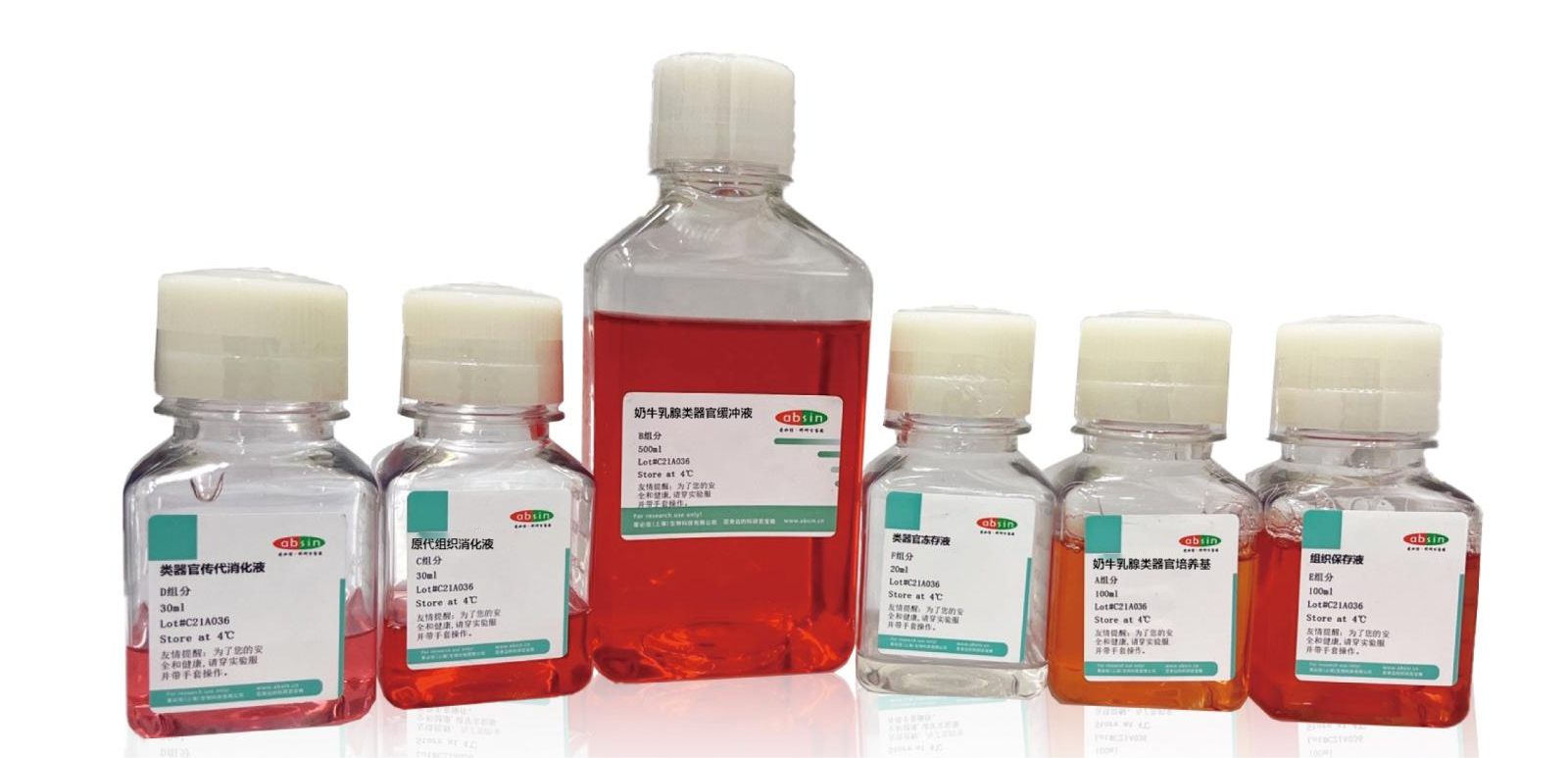
Absin provides antibodies, proteins, ELISA kits, cell culture, detection kits, and other research reagents. If you have any product needs, please contact us.
|
Absin Bioscience Inc. |
 Follow us on Facebook: Absin Bio Follow us on Facebook: Absin Bio |